
Orcas in Loreto: Understanding their presence
Encounters that must be earned

A family of orcas photographed in Loreto by Regina Domingo, captured on board a Baja Adventures marine expedition.
The presence of orcas in Loreto Bay National Marine Park is one of the most powerful wildlife experiences in the Gulf of California. As highly mobile odontocetes, they are always in motion, seen when conditions align, but never on a schedule.
Unlike many of the species that define Loreto and the Gulf, orcas are not resident to any location along the Baja California Peninsula. They move across vast ocean territories on both the Gulf and Pacific sides in search of prey, making encounters possible only when conditions align. While there is still much to study about their movements and ecology, what we have observed over the past decade reflects this constant, wide-ranging behavior.They can be seen in any season, but never on demand.
Their presence is dictated by a single force: prey availability.
And that is precisely what makes encountering them here so meaningful.
Not whales, but the largest dolphins on earth
Despite their common name [killer whales] orcas are not actually whales they are dolphins. The term “killer whale” is historically derived from the phrase “whale killer,” used by early observers describing orcas preying on large cetaceans. Over time, this term was linguistically inverted. In reality, orcas (Orcinus orca) exhibit highly specialized feeding strategies that vary between populations, including fish-eating, squid-feeding, and marine mammal predation. The name therefore reflects only a fraction of their ecological role and has contributed to a common misconception about their behavior.
They belong to the dolphin family (Delphinidae), making them the largest dolphins in the world.
This classification helps explain many of their defining traits:
Advanced intelligence and problem-solving abilities
Complex social structures and communication
Highly coordinated hunting strategies
Strong cultural transmission of behaviors within pods
In many ways, their dolphin lineage is what allows them to become such efficient and adaptable apex predators.
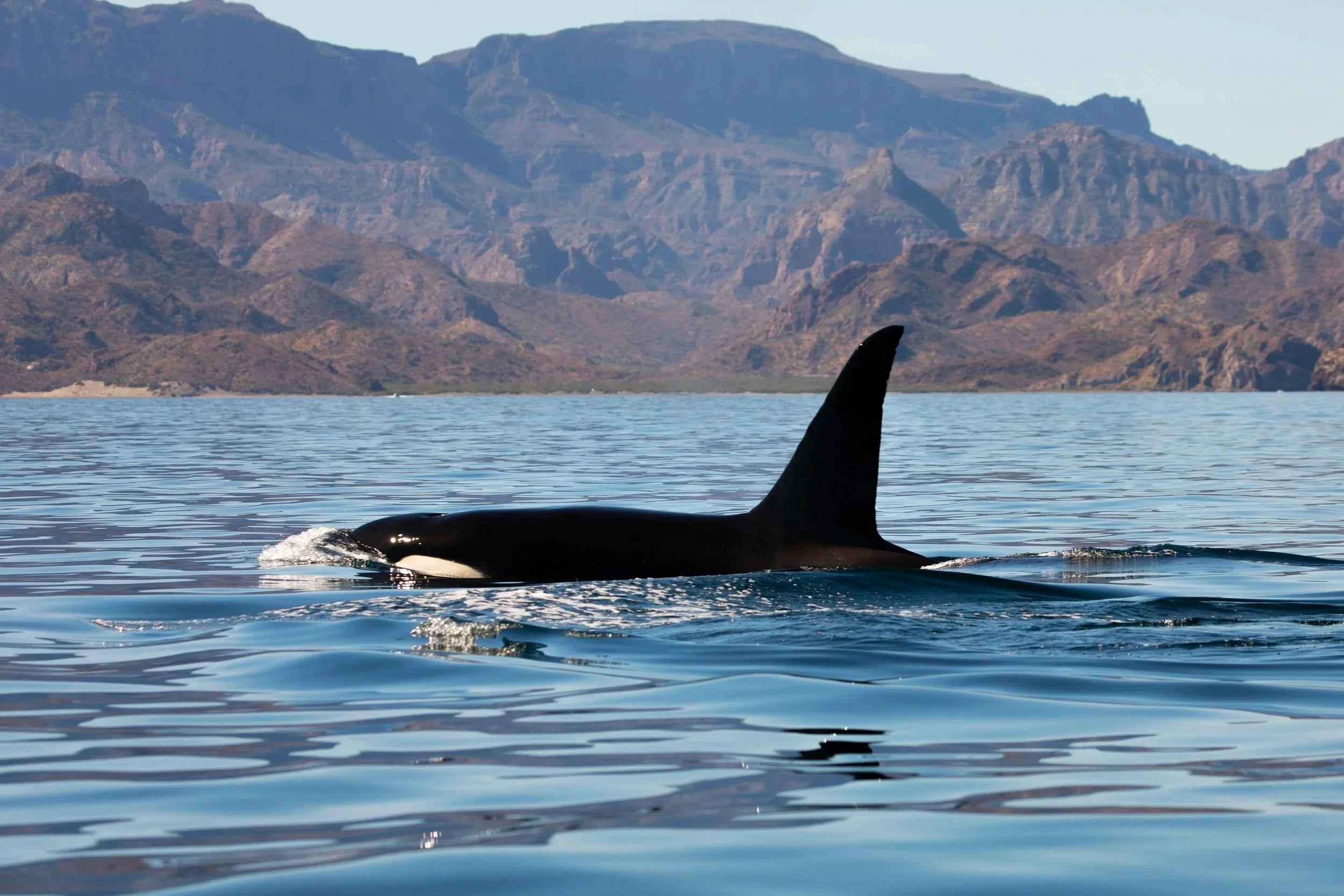
A orca male known as Cuitláhuac photographed in Loreto by Regina Domingo, captured on board a Baja Adventures marine expedition.
An apex predator shaped by intelligence
Orcas (Orcinus orca) are among the most intelligent and adaptable predators on Earth.
They are not a single uniform species in behavior. Across the world, distinct populations—or ecotypes—have developed specialized hunting strategies, diets, and even social structures. These are culturally transmitted within pods, meaning what they hunt and how they hunt is learned, not just instinctive.
Some key ecological traits:
Highly social, often living in structured pods with strong maternal lineages
Capable of traveling hundreds to thousands of kilometers
Apex predators with no natural predators
Diet varies dramatically between groups: fish, squid, rays, sharks, and marine mammals
In Loreto, this diversity of behavior becomes evident through the seasonal shifts in prey—and the orcas that follow them.
Why orcas are present in Loreto
The waters of the Gulf of California are among the most productive marine ecosystems in the world. Seasonal upwellings, island systems, and deep canyons create a mosaic of habitats that support extraordinary biodiversity.
Orcas arrive not because they belong here permanently—but because this ecosystem can sustain them, temporarily.
Different orca families appear at different times, each responding to specific ecological opportunities.
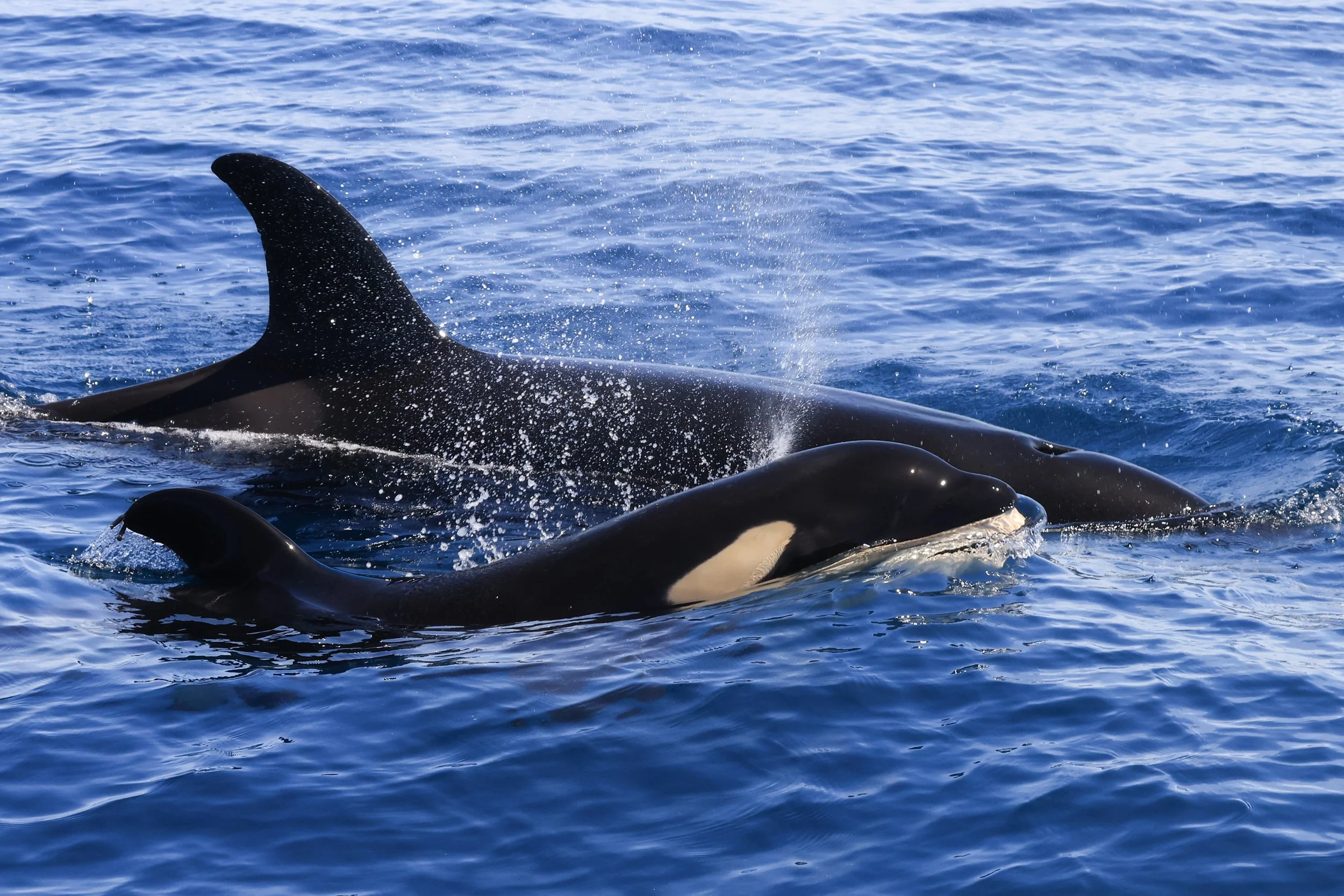
A juvenile orca alongside its mother, photographed in Loreto by Regina Domingo, captured on board a Baja Adventures marine expedition.
Seasonal Patterns & Feeding Behavior
Winter: Mammal eating Orcas
During winter, we occasionally encounter orcas that specialize in hunting marine mammals.
These individuals have been associated with interactions involving:
Fin whales
Blue whales
In some cases, these orcas target the tongue of baleen whales, one of the largest and most energy-rich food sources in the ocean.
These encounters are rare, intense, and often misunderstood—but they highlight the role of orcas as apex regulators within the ecosystem.
Spring : Dolphin Predation
In April and May, we have documented orcas actively preying on dolphins.
This period coincides with high dolphin activity in the region, including large “super pods.” Orcas use coordinated hunting techniques, leveraging intelligence and teamwork to isolate and capture prey.
These moments are fast, dynamic, and rarely predictable.
Late Spring & Summer: Squid, rays, mobulas , and sharks
As water temperatures rise and the ecosystem shifts, so do the orcas.
During late spring and into summer, we observe different feeding behaviors, including predation on:
Squid
Mobula rays
Rays
Sharks
This reflects the adaptability of orcas and reinforces the idea that each pod may represent a different ecological strategy.
No Resident Orcas in Baja
One of the most important facts about orcas in this region is simple:
There are no confirmed resident orca populations in the Baja California Peninsula.
Every encounter is transient.
Every sighting is part of a much larger oceanic movement.
This is why encounters are more likely during:
Periods of high prey concentration
Multi-day, long-distance expeditions
Efforts that prioritize exploration over fixed routes
OrcoX: A solitary visitor
In December 2025, we began documenting a solitary adult male orca in Loreto.
He was first identified by a partially damaged dorsal fin. Upon re-sighting him three months later, we documented significant changes, including a distinct X-shaped scar pattern extending from behind the blowhole toward the upper back near the saddle patch.
We named him: OrcoX
A record of interaction
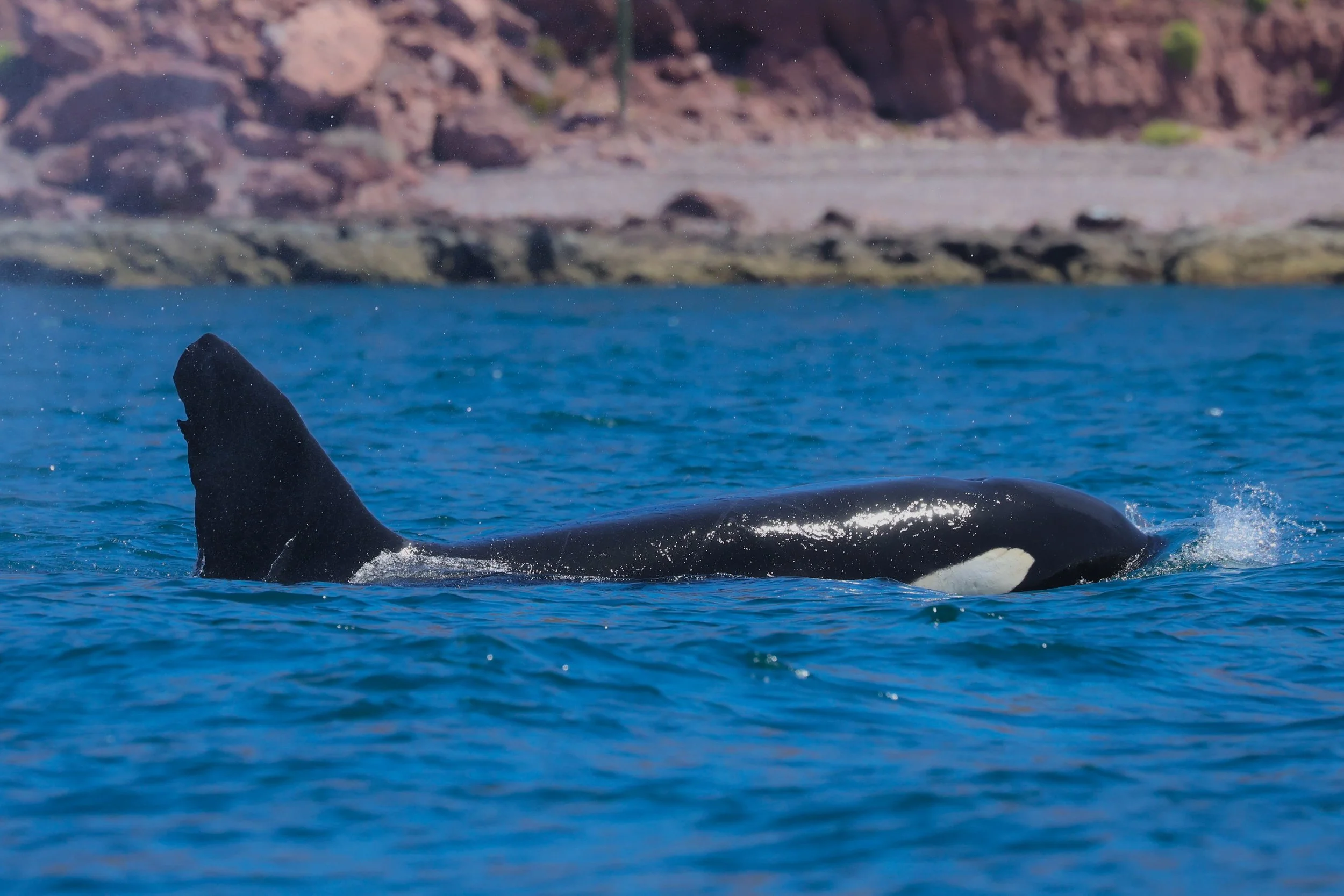
A solitary adult male orca, known as OrcoX, photographed in Loreto by Regina Domingo, captured on board a Baja Adventures marine expedition.
The origin of these markings remains uncertain.
Their linear, intersecting nature suggests a possible anthropogenic interaction, such as entanglement with fishing gear. However, without direct observation, this remains speculative.
Scars like these are often physical records of the increasingly complex relationship between marine megafauna and human activity.
Behavior & feeding clues
OrcoX has been consistently observed alone.
While adult males may travel independently, his behavior offers important clues:
He has been seen around whales without disturbing them, suggesting he may not be a mammal-eating orca
He has been observed beneath fishing boats, feeding on jacks and other fish
New markings have appeared over time, adding to his evolving story
Despite this, he appears to be in stable condition—actively swimming, navigating, and feeding.
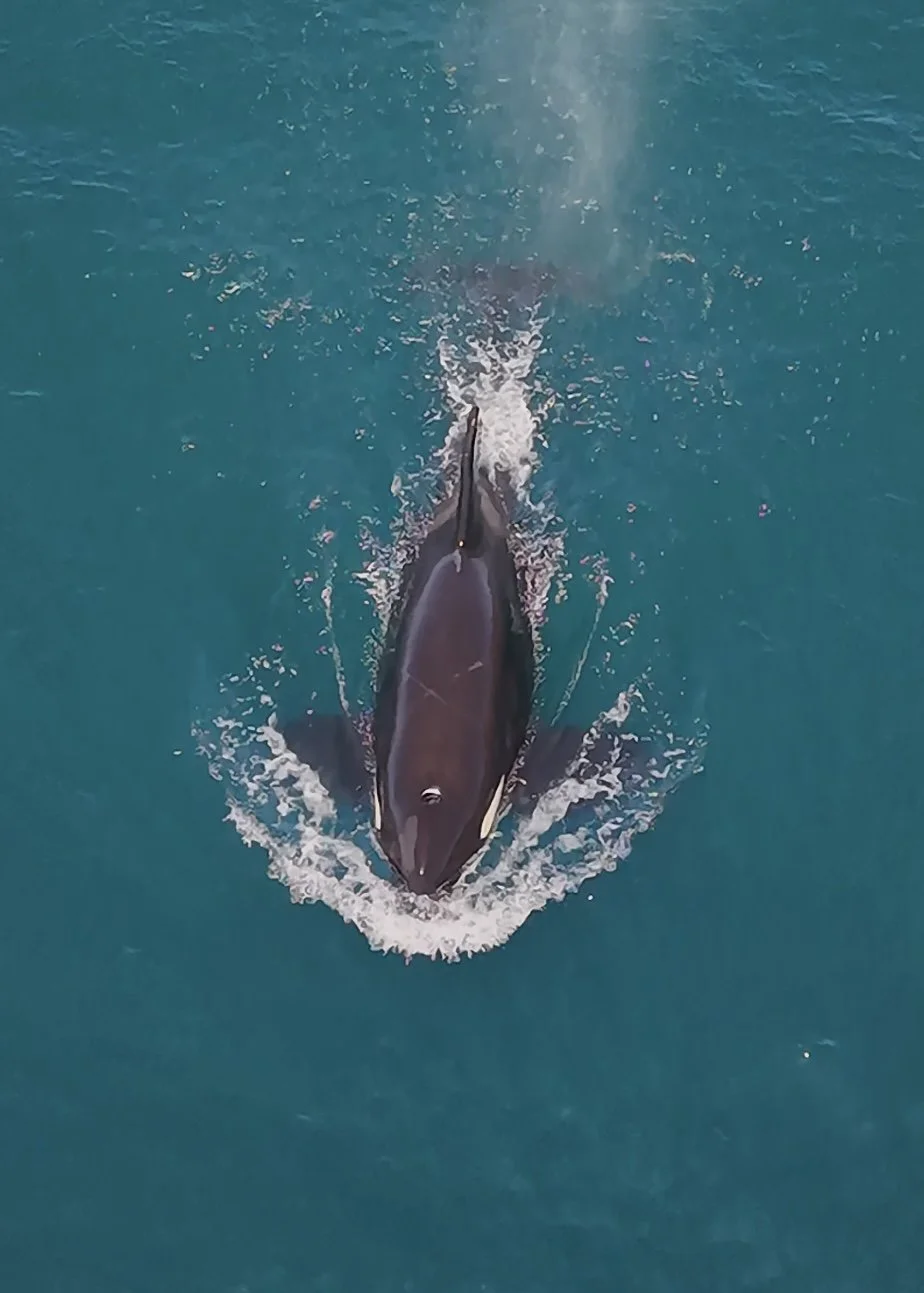
A solitary adult male orca, known as OrcoX, photographed in Loreto by Leopoldo Sanmiguel, captured on board a Baja Adventures marine expedition.
What orcas teach us about 2xploration
If orcas are what you hope to see in Loreto, there is something important to understand:
They will not come to you easily.
In many ways, orcas become the ultimate teachers of this place.
To encounter them, you are required to:
Spend time on the water
Travel distance
Understand the rhythms of the ecosystem
Experience the full biodiversity of the Gulf of California
Because to see a top predator, you must first understand everything that allows it to exist.
The krill blooms.
The sardine schools.
The dolphins.
The rays.
The whales.
The structure of the islands and the currents that connect them all.
Orcas are not the beginning of the story.
They are the culmination of it.
The Baja Adventures Perspective
At Baja Adventures, we don’t design expeditions around a single species.
We design them around ecosystems.
Because when you truly explore Loreto, you begin to understand that every encounter is connected, and that the rarest moments are a reflection of everything working in balance.
And sometimes, when that balance reveals itself fully,
you find yourself in the presence of orcas.

A juvenile orca feeding on a mobula ray, photographed in Loreto by Regina Domingo, captured on board a Baja Adventures marine expedition.
Plan your expedition
If encountering orcas is part of your vision, the best approach is to join extended, long-distance marine expeditions or a Loreto Islands expedition designed to maximize time, range, and ecological understanding.
Not just to increase your chances of seeing them, but to understand why they are here at all.
Because in Loreto, the greatest reward is not just the sighting, it’s the journey that leads you to it.
And remember : Orcas are not a ‘tour.’ Choose real expeditions in Baja Caliornia Sur guided by certified experts who understand ecosystems, respect wildlife, and operate with safety, ethics, and integrity.