
Blue Whale Season in Loreto: Best Time to See Whales & Complete Watching Guide
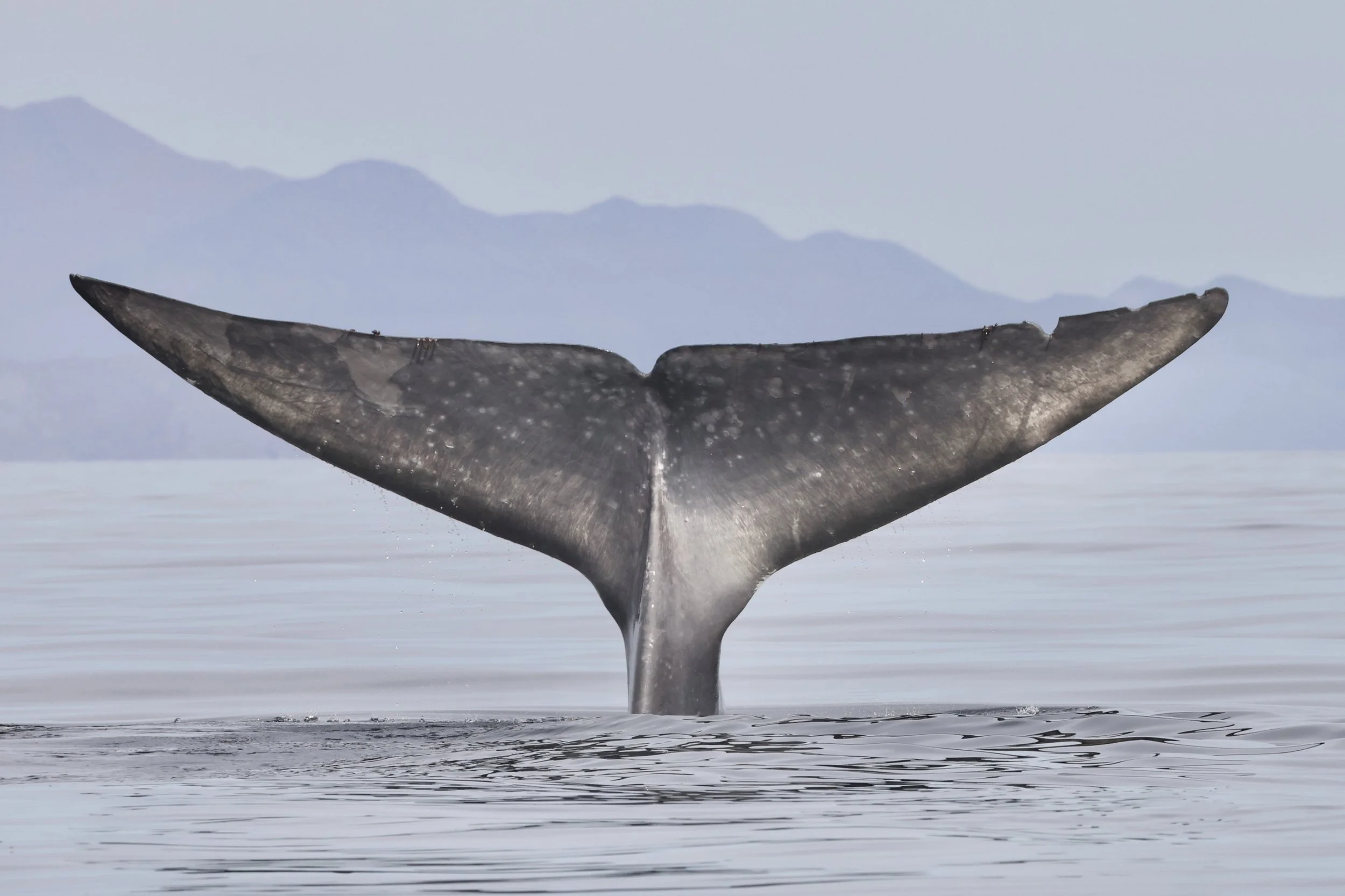
Blue whale season in Loreto Bay National Park, Gulf of California. Photo: Regina Domingo / Baja Adventures.
There is a moment during winter in Loreto when everyone aboard suddenly looks in the same direction.
A blow appears on the horizon.
Sometimes it belongs to a humpback or fin whale. Sometimes dolphins appear first. And sometimes, slowly emerging from Gulf of California also known as the Sea of Cortez, it belongs to the largest animal known to have ever lived on Earth: the blue whale (Balaenoptera musculus).
Whale season in Loreto is much more than a wildlife encounter. It is an opportunity to understand one of the world's most productive marine ecosystems and the relationship between whales, oceanography, prey, conservation and people.
At Baja Adventures, our whale expeditions combine small-group wildlife observation, citizen science, education, conservation and regenerative tourism, led by two bilingual expert guides and an experienced local captain.
We don't simply go looking for whales. We explore the ecosystem that brings them here.
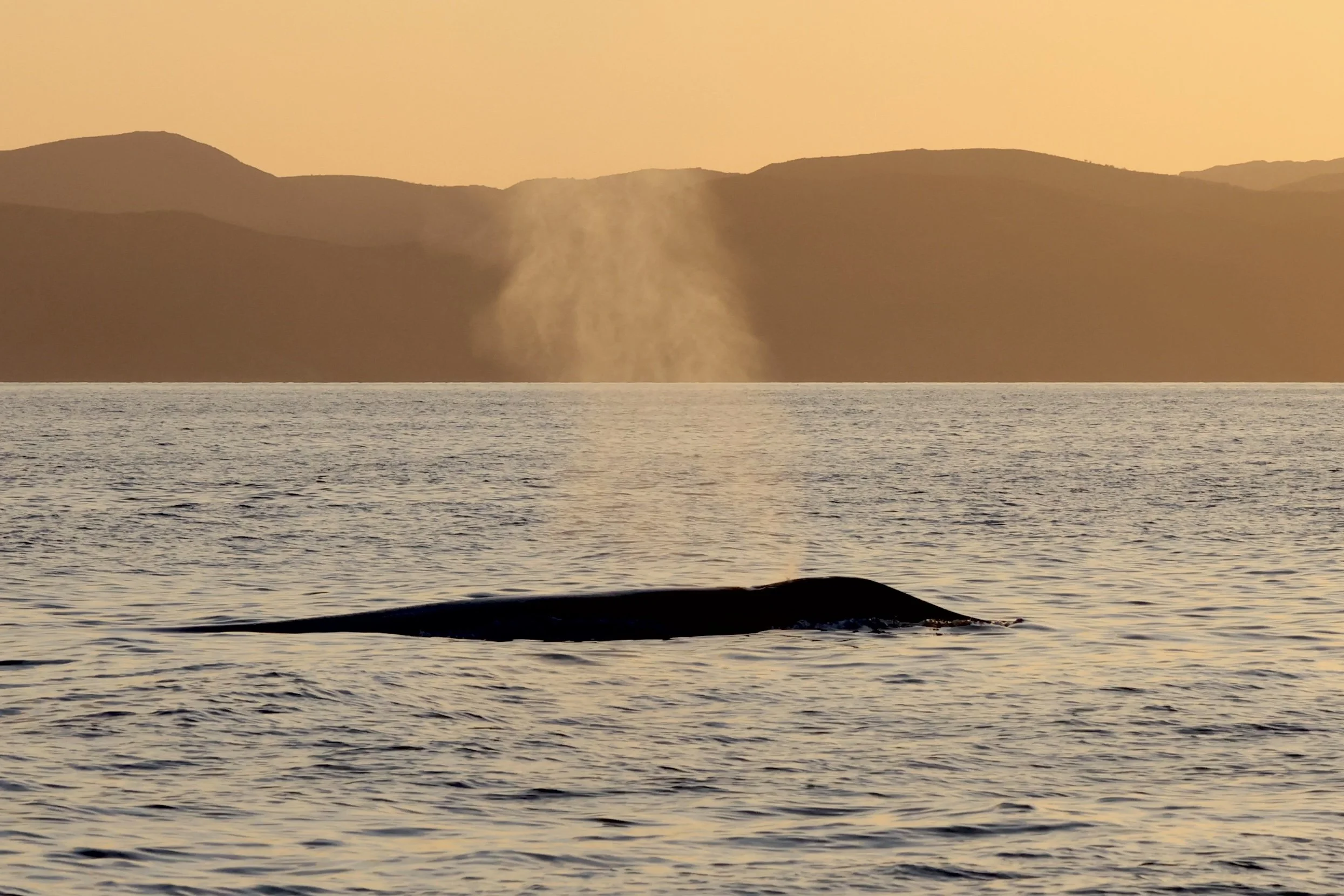
A blue whale breathes in the first light of sunrise off Loreto, captured by Baja Adventures expedition leader and wildlife photographer Regina Domingo.
When is whale season in Loreto?
The official whale-watching season in Loreto Bay National Park and its surrounding area runs from January through April.
Blue whales are generally observed around Loreto from late January through April, although their arrival, distribution and abundance vary every year.
For travelers specifically hoping to encounter blue whales, late January through mid-March is typically the period we concentrate most of our blue-whale expeditions, while March and April can also bring other extraordinary cetacean activity.
There is no exact date when whales suddenly arrive or leave.
Whales respond to the ocean—not our calendar.
Water conditions, wind, currents, productivity and, most importantly, the distribution of prey all influence where animals are found.
And because these are wild animals, sightings can never be guaranteed.
For a broader overview of the species found here, explore our complete guide to the whales of Loreto.
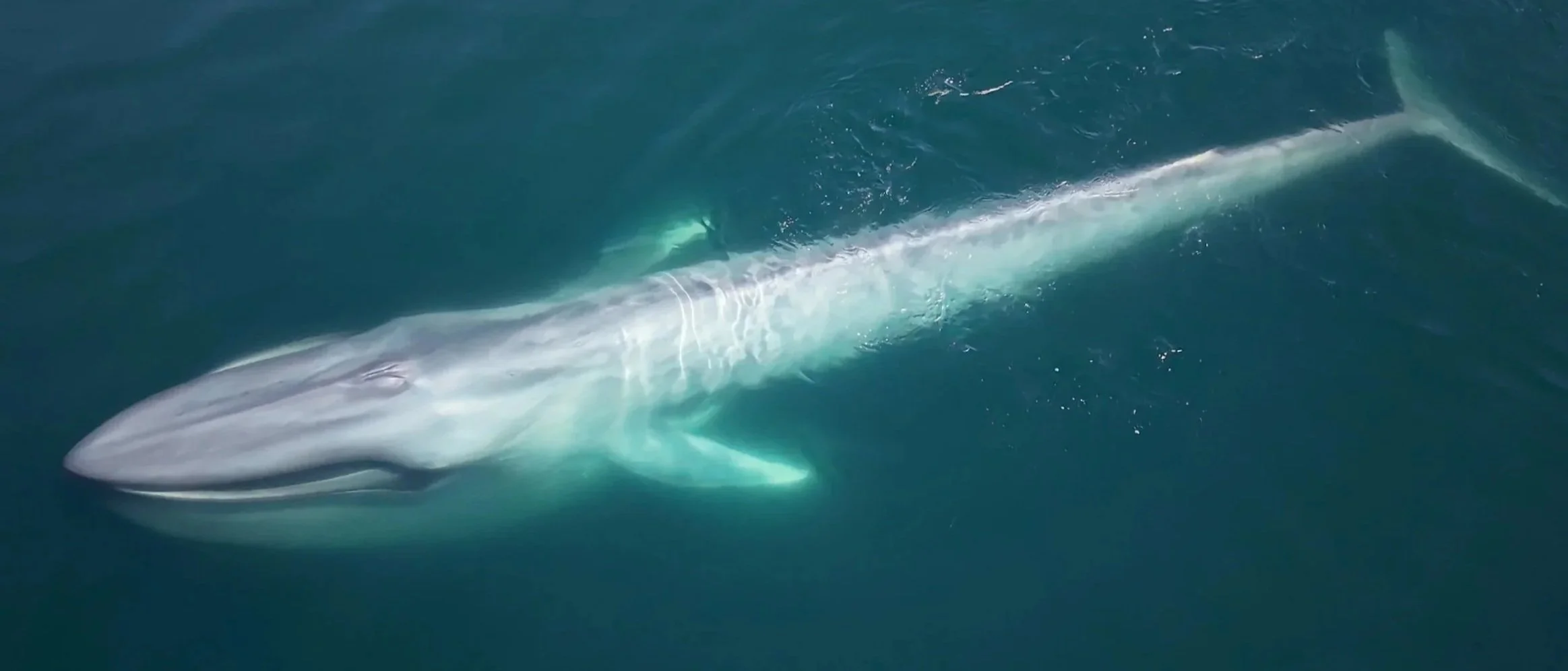
Blue whales are generally observed around Loreto from late January through April, with annual variation in arrival and distribution.
Why do blue whales come to Loreto and the Gulf of California?
The answer begins with food.
Despite their extraordinary size, blue whales feed primarily on tiny crustaceans called krill.
Seasonal oceanographic processes in the Gulf of California support high biological productivity. Nutrients fuel phytoplankton, which supports zooplankton and krill, ultimately creating feeding opportunities for some of the largest predators on the planet.
It is an extraordinary food web:
nutrients → phytoplankton → zooplankton and krill → blue whales.
During periods of intense feeding, a blue whale can consume several tonnes of krill in a day.
But the Gulf of California is not important only for feeding. Long-term research has also identified the southwestern Gulf as important habitat for reproduction and nursing calves.
This is one of the reasons Loreto is such an extraordinary place to study and observe blue whales.
These conditions change every year. See what we documented when blue whales returned to Loreto in 2026
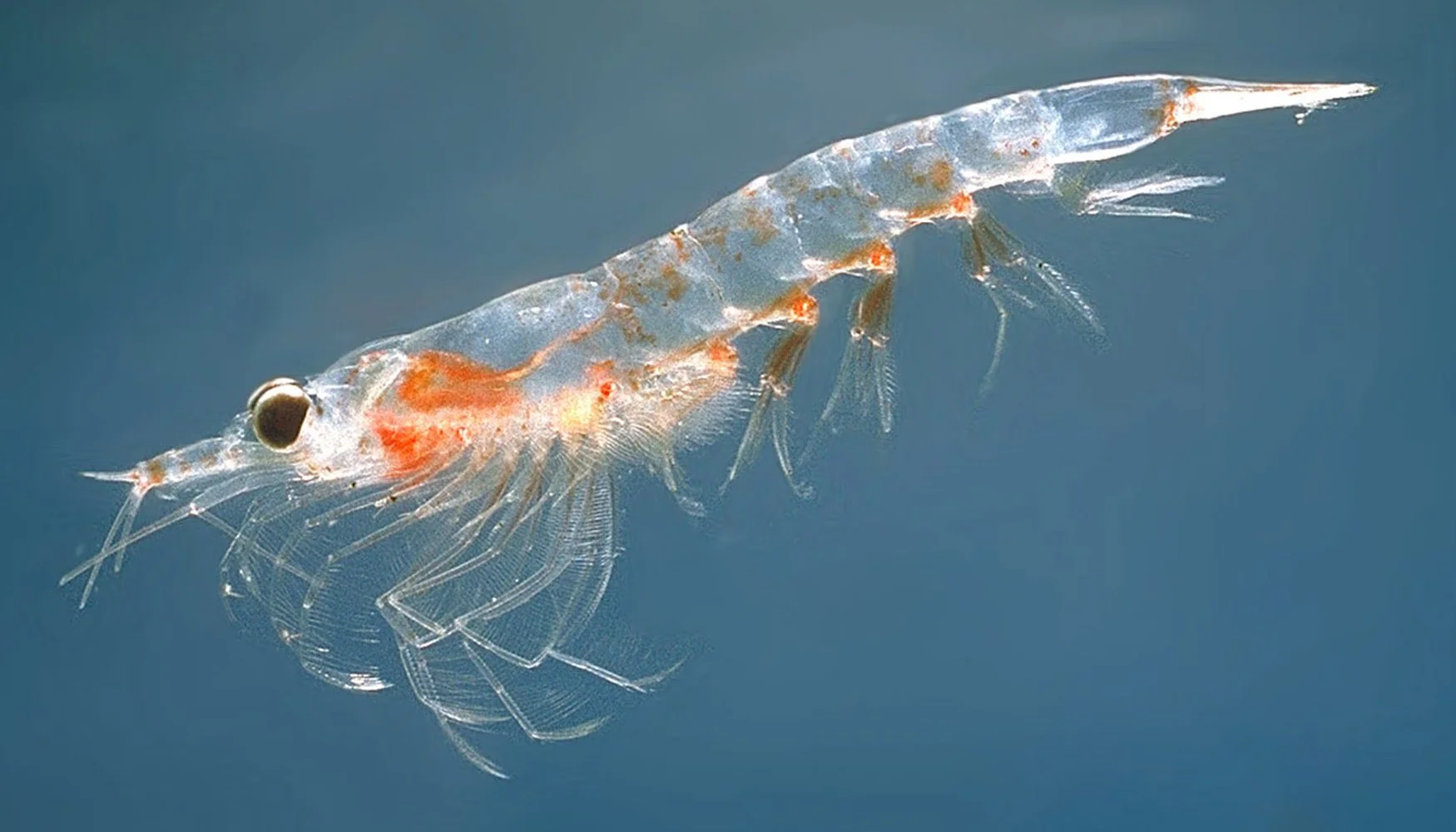
Tiny prey, enormous predator: blue whales feed primarily on krill, connecting ocean productivity to the largest animal on Earth photo source Wikipedia.
How big is a blue whale?
Blue whales are the largest animals known to have lived on Earth, larger even than the largest dinosaurs known from the fossil record.
Some adults can approach 30 meters in length, and the largest individuals can weigh well over 100 tonnes.
Blue whales observed in the Gulf of California are typically around 20–24 meters long, with females generally larger than males. Scientific photogrammetry studies in these waters have documented exceptionally large females approaching 29 meters. Calves are only around 7 meters long at birth.
But numbers don't really prepare you for seeing one.
Often the first sign is simply a distant blow. Then the head and blowholes break the surface, followed by an apparently endless blue-gray back.
Because the animal is so long, several seconds can pass before the small dorsal fin finally appears.
You may never see the entire whale at once.
And somehow, that makes its scale even more impressive.

What do blue whales eat, and how do they feed?
Blue whales are baleen whales.
Instead of teeth, they have plates of baleen that allow them to filter enormous quantities of water while retaining their prey.
They commonly use a strategy called lunge feeding, accelerating toward dense patches of krill and engulfing an immense volume of prey-filled water before filtering it through their baleen.
This requires a tremendous amount of energy.
That is why simply having krill in the ocean is not enough. The prey needs to occur in sufficiently dense concentrations to make feeding energetically worthwhile for an animal of this size.
Understanding where prey concentrates helps us understand why whales appear in particular areas—and why their distribution can change from one year to another.
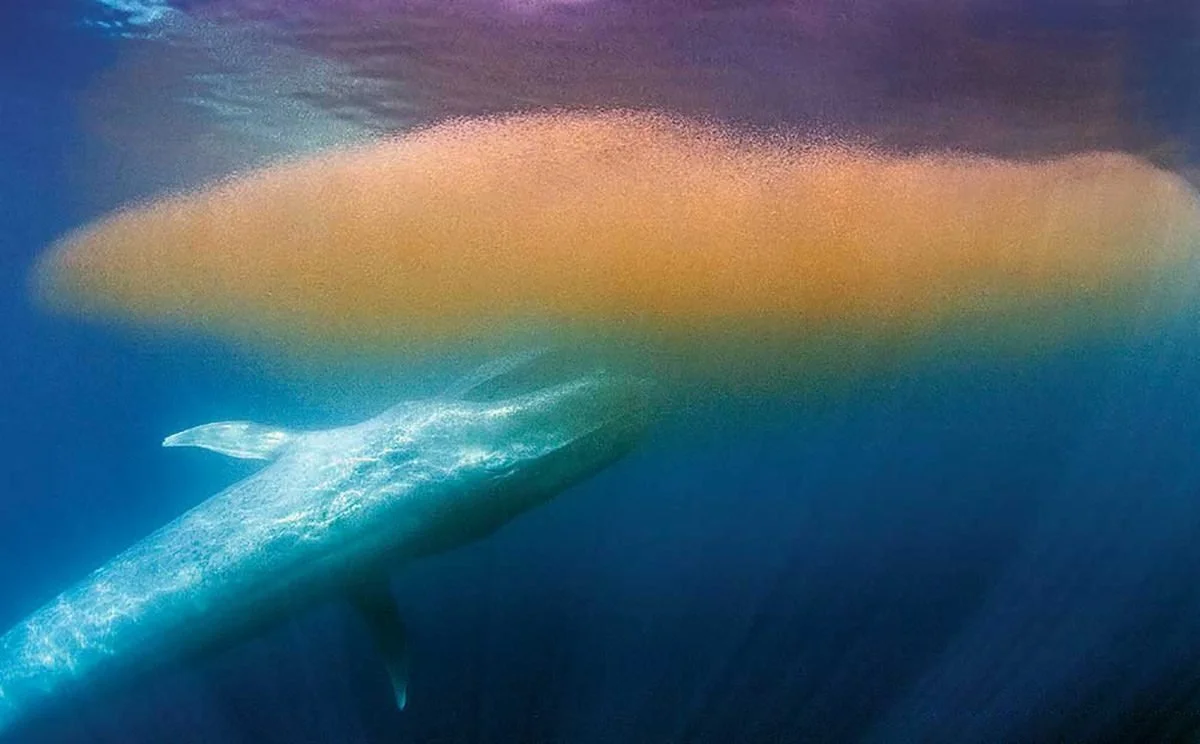
Blue whales travel to productive Gulf of California waters where dense concentrations of krill provide important feeding opportunities photo by Richard Herrmann
How long do blue whales live?
We don't know the exact maximum lifespan of a blue whale.
Current scientific estimates generally place their average lifespan at approximately 80–90 years, and some individuals may potentially live longer.
Think about what that means.
A whale visiting Loreto today may have experienced decades of changes in ocean temperatures, prey availability, fisheries, vessel traffic, underwater noise and climate.
And remarkably, researchers can recognize some of these individuals across many years.
How do scientists recognize individual blue whales?
Look carefully at a blue whale and its skin isn't simply blue-gray.
Each animal carries distinctive pigmentation patterns, and researchers can also use characteristics of the dorsal fin and other identifying features to recognize individuals through photography.
This technique is called photo-identification.
The long-term blue-whale research program coordinated by Dr. Diane Gendron at CICIMAR-IPN has studied blue whales around the Baja California Peninsula for decades. Its photo-identification catalog contains hundreds of individually recognized whales and allows researchers to build long-term histories of particular animals.
Baja Adventures collaborates by contributing suitable photographic records from our fieldwork to this long-term blue-whale identification effort.
For us, this changes the meaning of wildlife photography.
A photograph can become data.
The whale surfacing beside us today may be an individual scientists have documented repeatedly over many years.
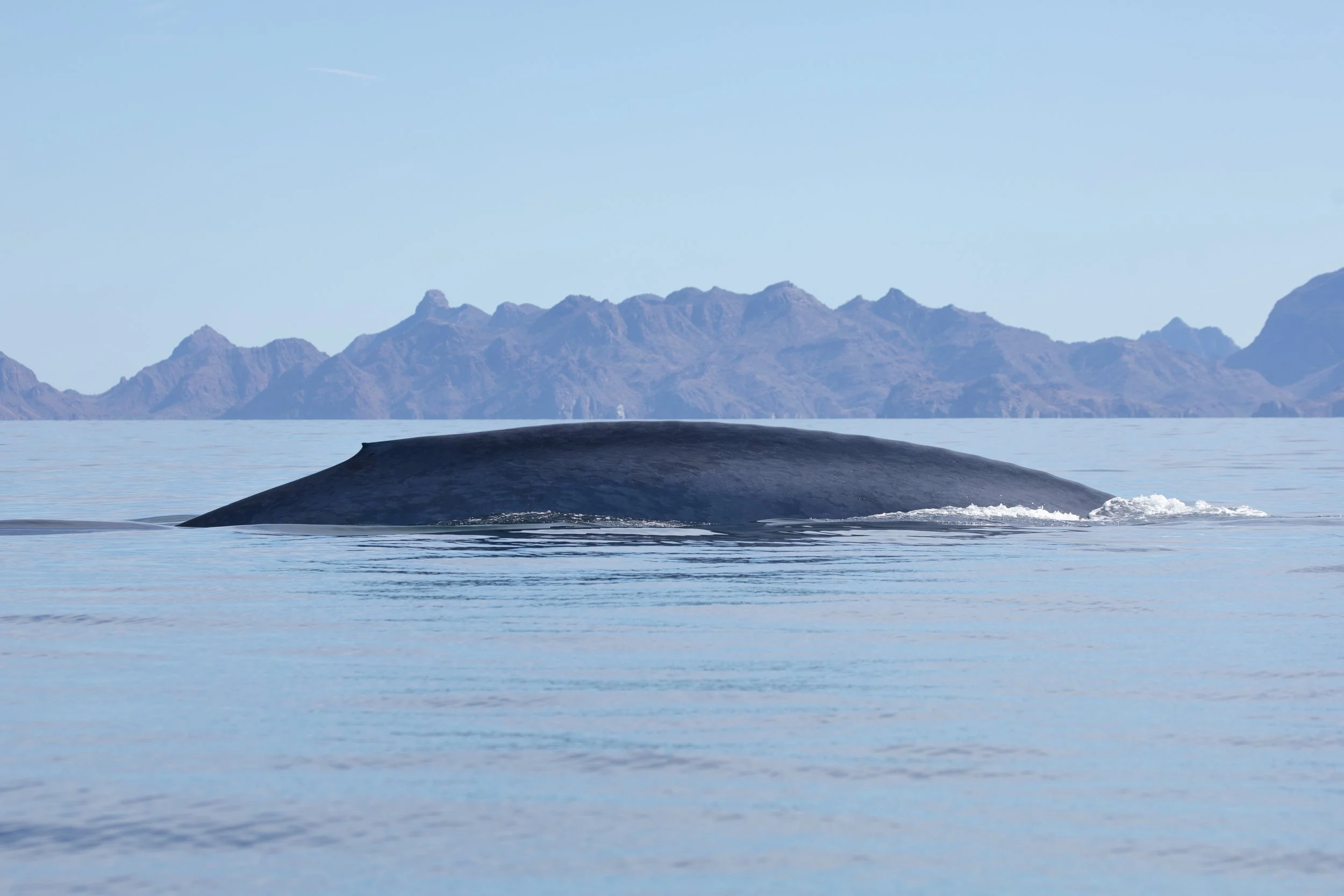
Every blue whale carries distinctive pigmentation patterns that can allow researchers to recognize individuals across years and decades photo by our expedition leader Regina Domingo in Loreto.
Can you see mothers and calves in Loreto?
Yes. Females with calves are among the blue whales documented in the Gulf of California.
Long-term CICIMAR research recognizes the southwestern Gulf as a feeding, reproductive and nursery area for this population.
That makes responsible observation especially important.
Mother-calf pairs require additional consideration, and vessels should never separate a calf from its mother, obstruct their movement or deliberately pressure them into an interaction.
Our objective is always to observe natural behavior, not change it.
During the 2026 season, our team documented this behavior while monitoring blue whales in Loreto. Read our 2026 blue whale season field report.
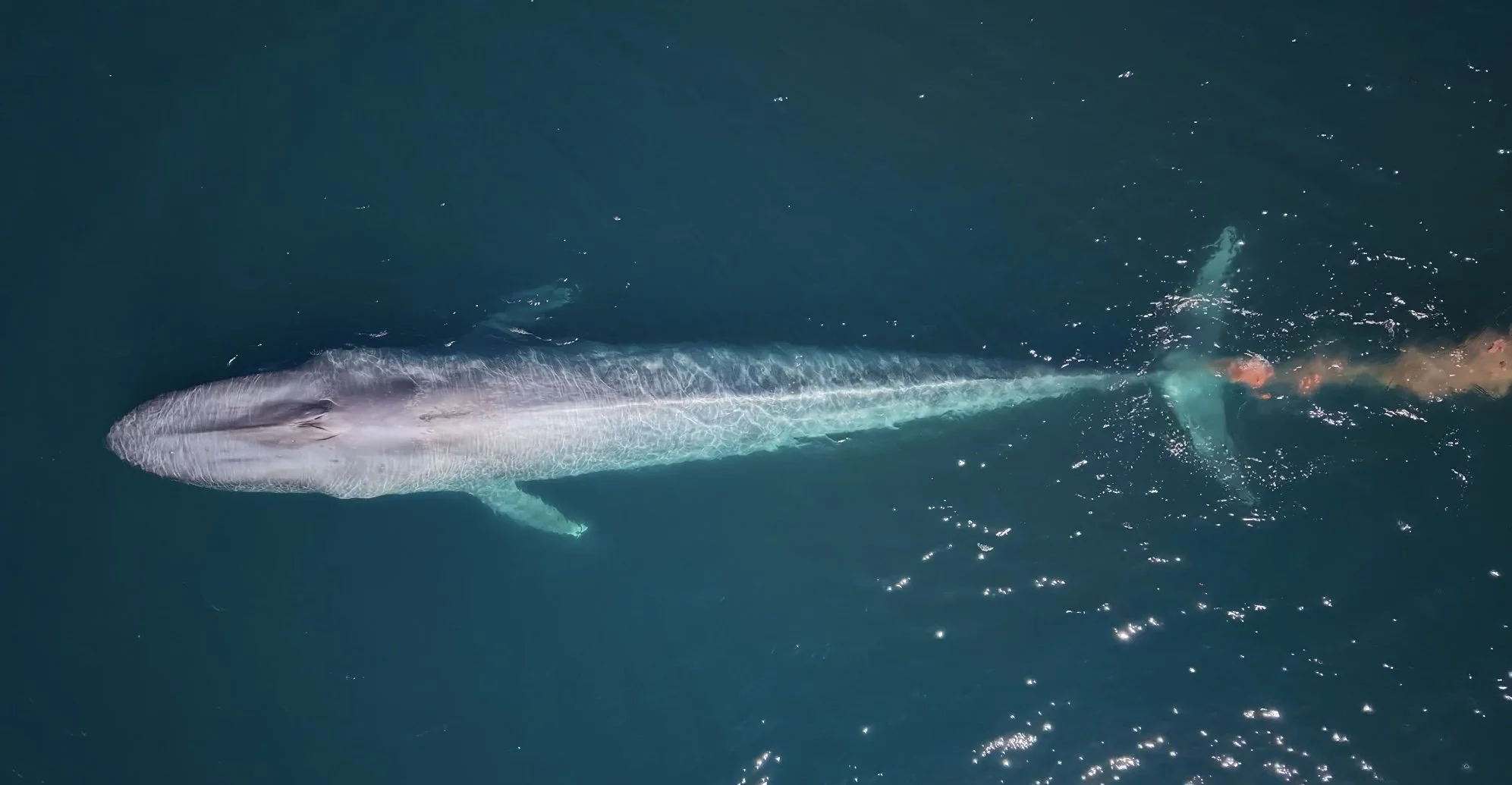
Blue whales don't only depend on productive oceans, they also help recycle nutrients through them. Whale feces return nutrients to surface waters, contributing to marine nutrient cycling. Photo: Baja Adventures.
What other whales can you see during whale season in Loreto?
Blue whales may be the icons of winter in Loreto, but they are part of a much larger cetacean community.
Depending on the month, ocean conditions and prey, encounters during whale season may include:
Blue whales — the largest animal on Earth and the signature species of Loreto's winter whale season.
Humpback whales — seasonal visitors known for their surface activity, songs and distinctive flukes.
Fin whales — the second-largest whale species on Earth and an important cetacean of the Gulf of California.
Orcas — present in the Gulf throughout the year, but unpredictable. An encounter should always be considered an extraordinary possibility rather than an expectation.
Dolphins and other cetaceans — bottlenose dolphins, common dolphins and other species may also be encountered.
This is why we never treat a whale expedition as a search for only one species.
Every day tells a different ecological story.
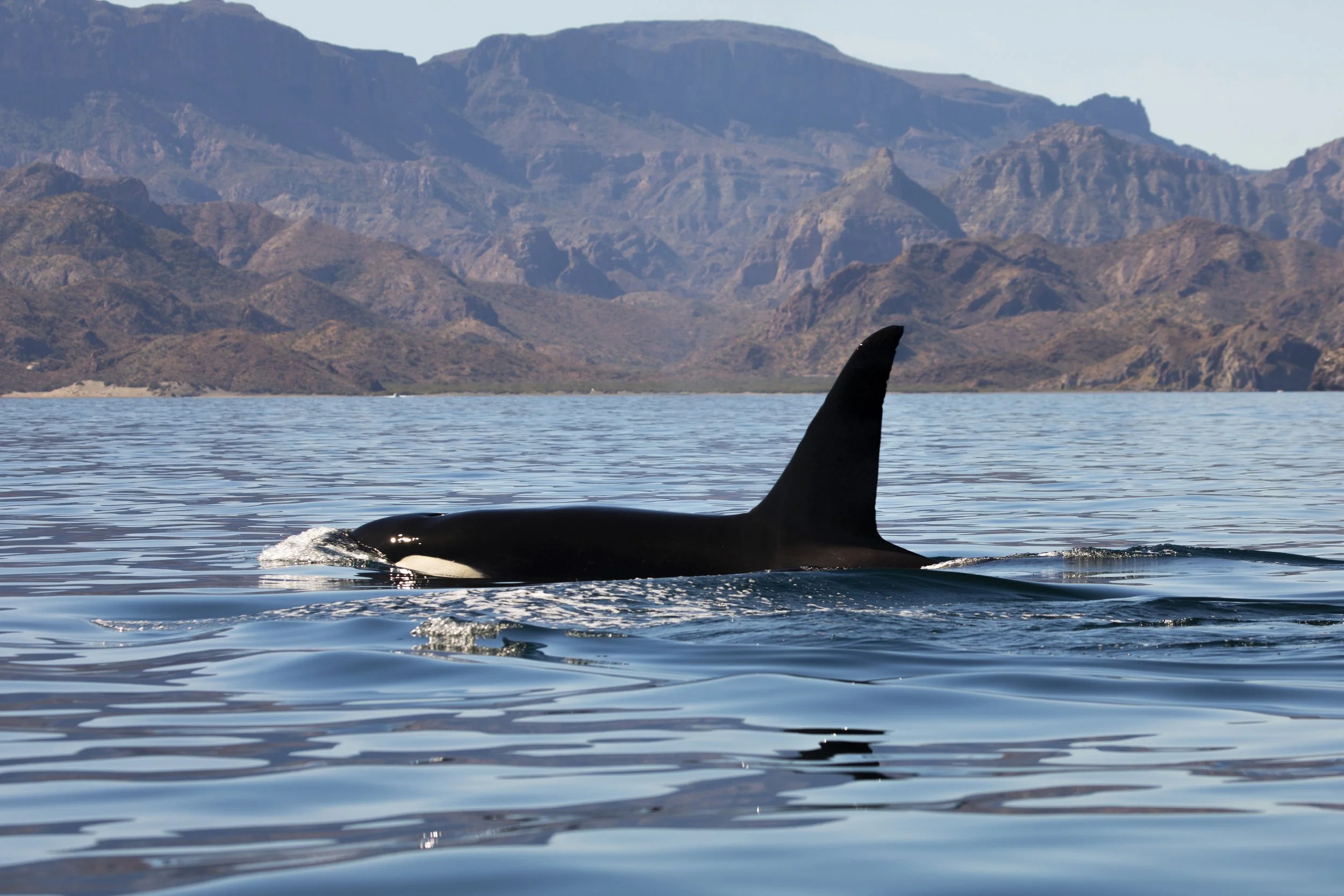
Orcas occur year-round in the Gulf of California, but encounters around Loreto remain unpredictable and should always be considered extraordinary. Photo: Regina Domingo
Can you see gray whales from Loreto?
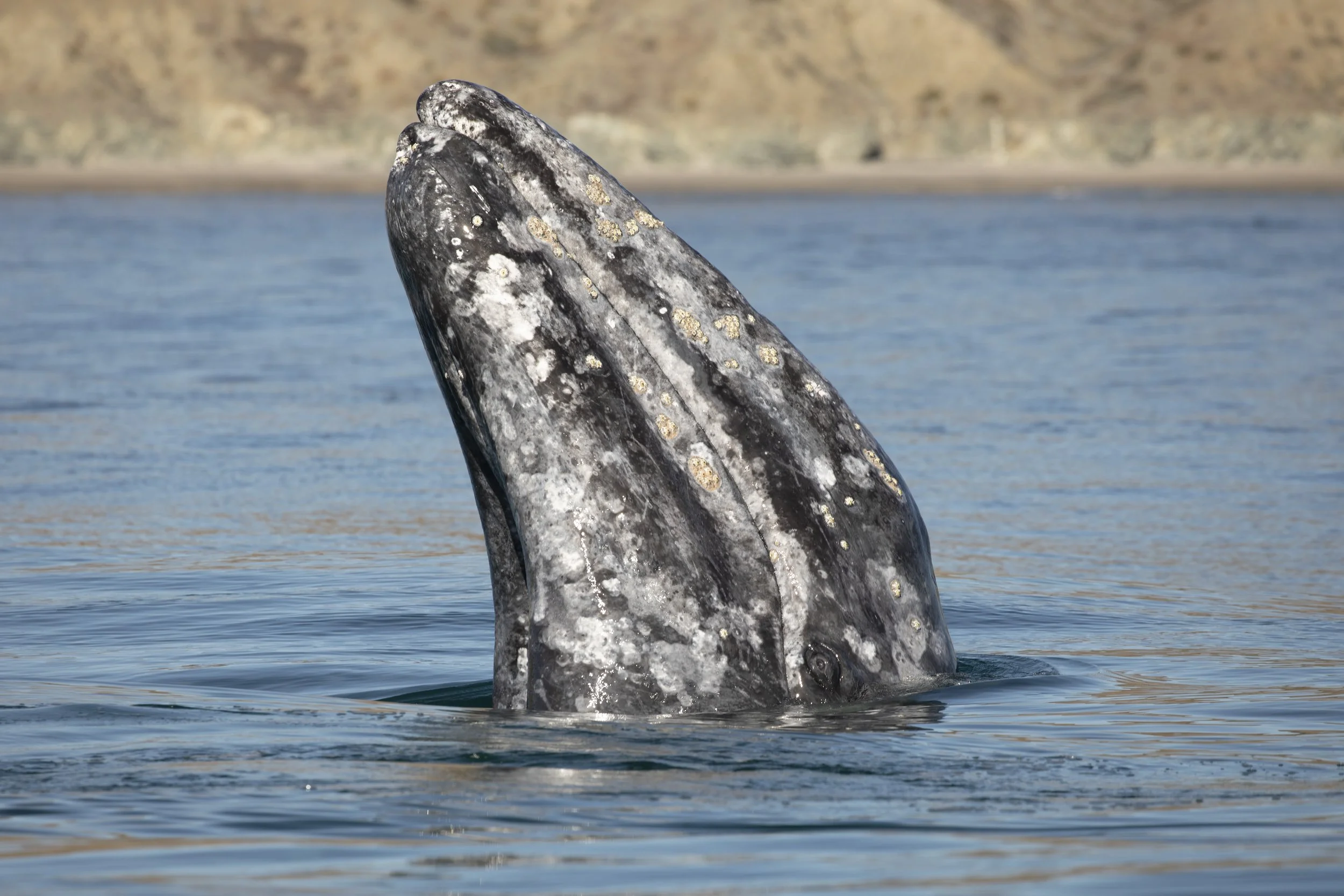
Gray whales concentrate in Pacific lagoons; Baja Adventures connects selected whale itineraries and adventures from Loreto to these winter habitats.
Yes—but there is an important distinction.
Gray whales are not the principal whale-watching species of Loreto Bay.
Their famous winter aggregation areas are located on the Pacific side of the Baja California Peninsula, including Laguna San Ignacio, Ojo de Liebre and the Bahía Magdalena region.
Baja Adventures incorporates gray-whale experiences into selected private expeditions and multi-day whale itineraries from Loreto.
We travel from Loreto in our own 4x4 expedition vehicle, La Cachalote. Depending on the lagoon and conditions, overland transportation takes approximately 2–3 hours each way, while the gray-whale expedition itself lasts approximately 5–6 hours.
This allows travelers based in Loreto to experience two completely different whale ecosystems during the same journey.
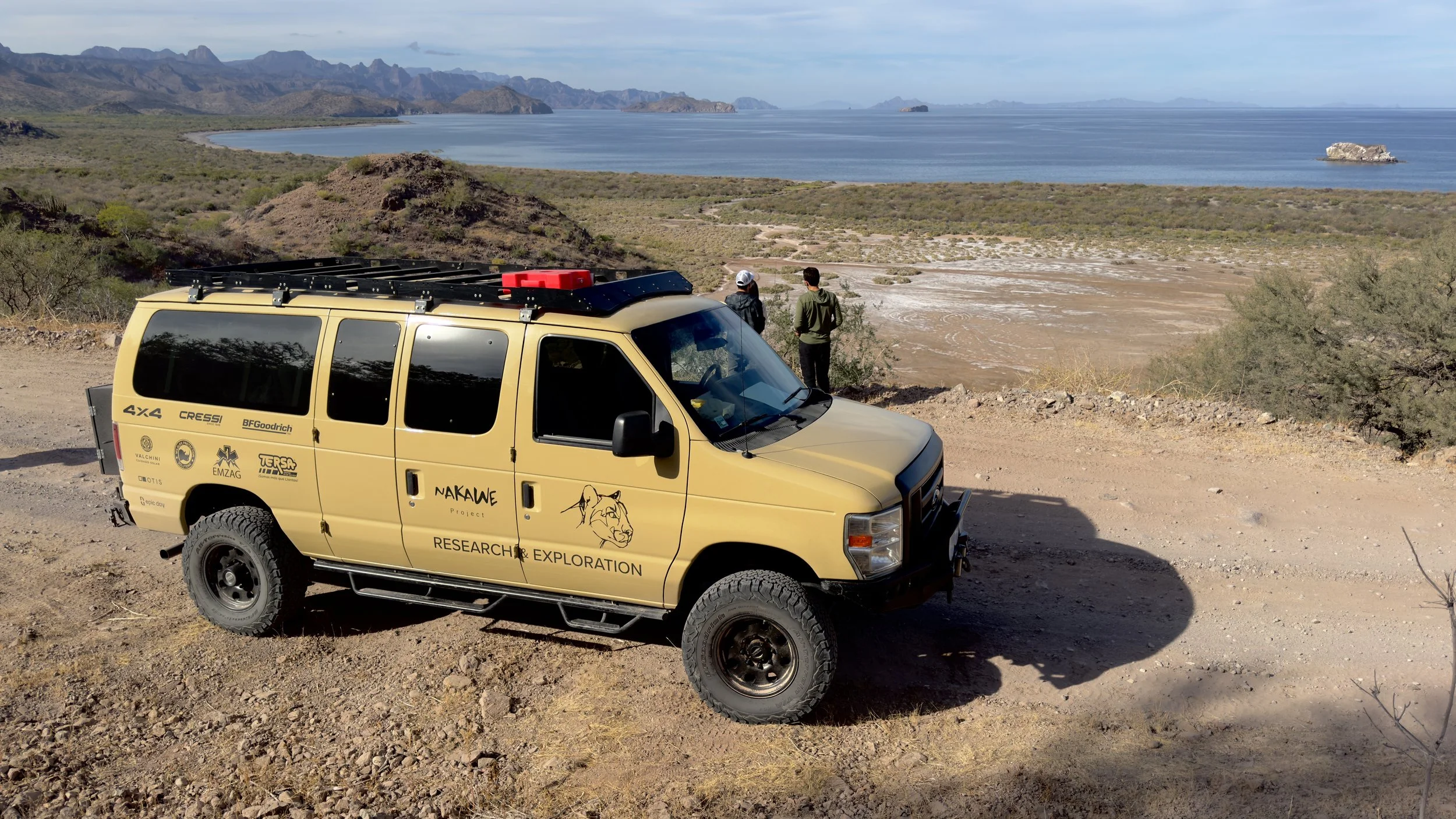
La Cachalote, our 4x4 expedition vehicle, connects Loreto with remote Baja landscapes and selected Pacific gray-whale expeditions.
What is a whale-watching expedition in Loreto really like?
Whale watching requires something that cannot be rushed: patience.
There is no marked location in the ocean where a whale will appear.
Our guides scan the horizon for blows, birds, surface activity, movement and other environmental clues. We observe the sea, interpret conditions and use our accumulated field knowledge to decide where to explore.
Sometimes wildlife appears quickly.
Sometimes we search.
And during that search, you begin noticing everything else: the islands, seabirds, dolphins, changing light, ocean conditions and the immense Sierra de la Giganta rising behind Loreto.
At Baja Adventures, we don't operate a fixed wildlife circuit.
We follow the ecosystem.
Our whale expeditions also incorporate citizen-science observations, photography, educational interpretation and, when conditions are appropriate, the use of our hydrophone to explore the underwater acoustic environment.
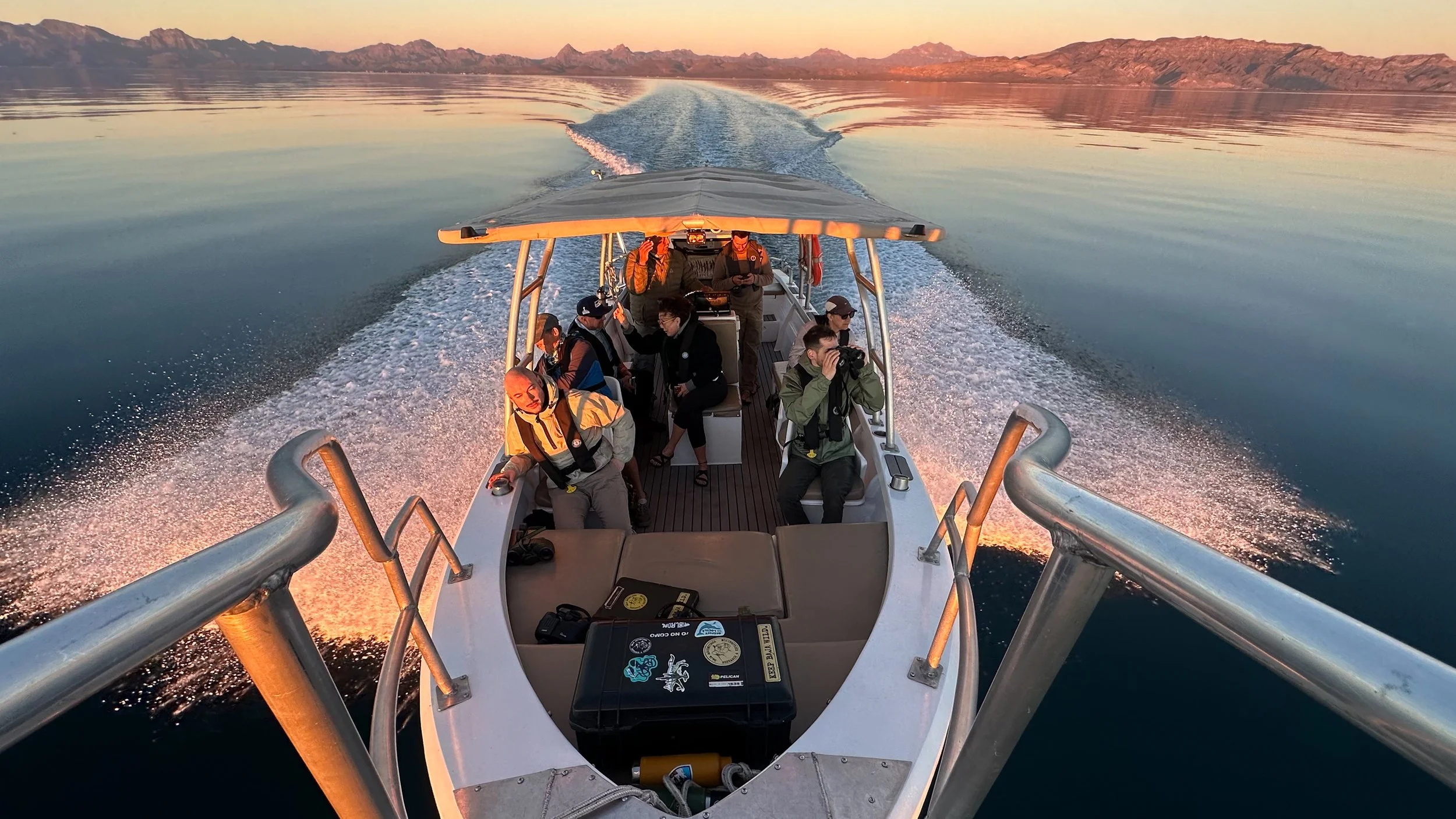
La Puma from her wildlife-observation bow: our 27-foot expedition vessel features individual orthopedic seating, extensive shade, dry storage and an onboard WC, designed for comfortable full-day wildlife expeditions in Loreto Bay National Park.
Are whale sightings guaranteed?
No.
And we believe every responsible wildlife operator should be very clear about this.
Whales are wild animals moving freely through an enormous marine ecosystem. Their location and behavior are influenced by prey availability, oceanographic conditions, weather, wind, currents, migration, reproduction and many other natural variables.
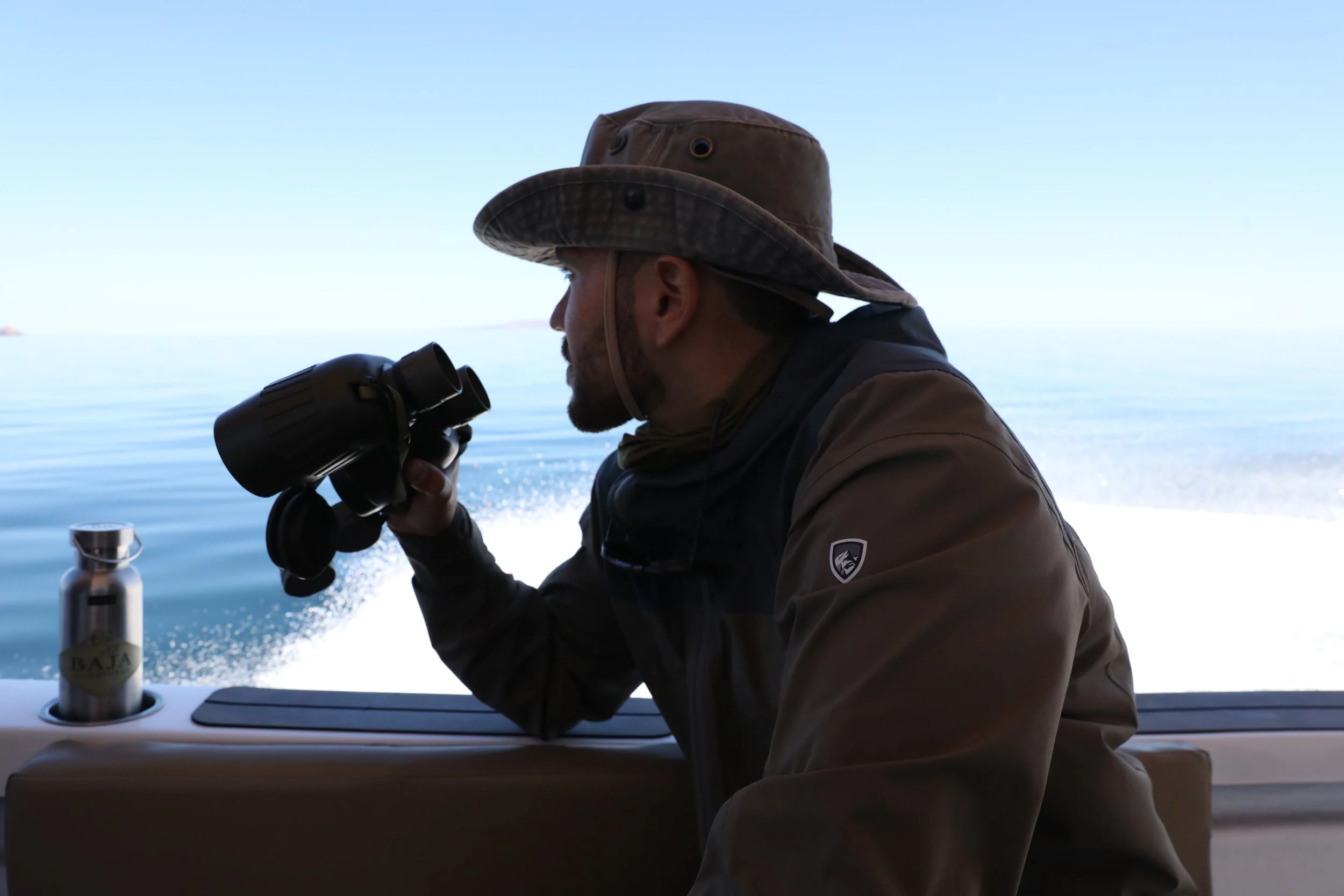
Baja Adventures founder and expedition leader Leopoldo Sanmiguel scanning the horizon for whale blows during a whale-watching expedition in Loreto.
Even during peak season, two consecutive days can be completely different.
However, experience and continuous presence in the field can make a significant difference. Our team lives in Loreto year-round and monitors cetaceans throughout the seasons, dedicating hundreds of hours to field observation and contributing to ongoing cetacean distribution analysis in Loreto Bay National Park and surrounding waters.
That continuous effort gives us a deeper understanding of seasonal movements, changing distribution, environmental conditions and the areas where different species have recently been observed. It doesn't allow us to predict wildlife or guarantee an encounter, but it gives our guides valuable knowledge when deciding where, when and how to search.
We don't simply arrive in Loreto for whale season. We observe this ecosystem year-round.
That uncertainty is not a failure of wildlife tourism. It is part of experiencing wildlife on its own terms, and one of the reasons that knowledge, field experience and time on the water matter.
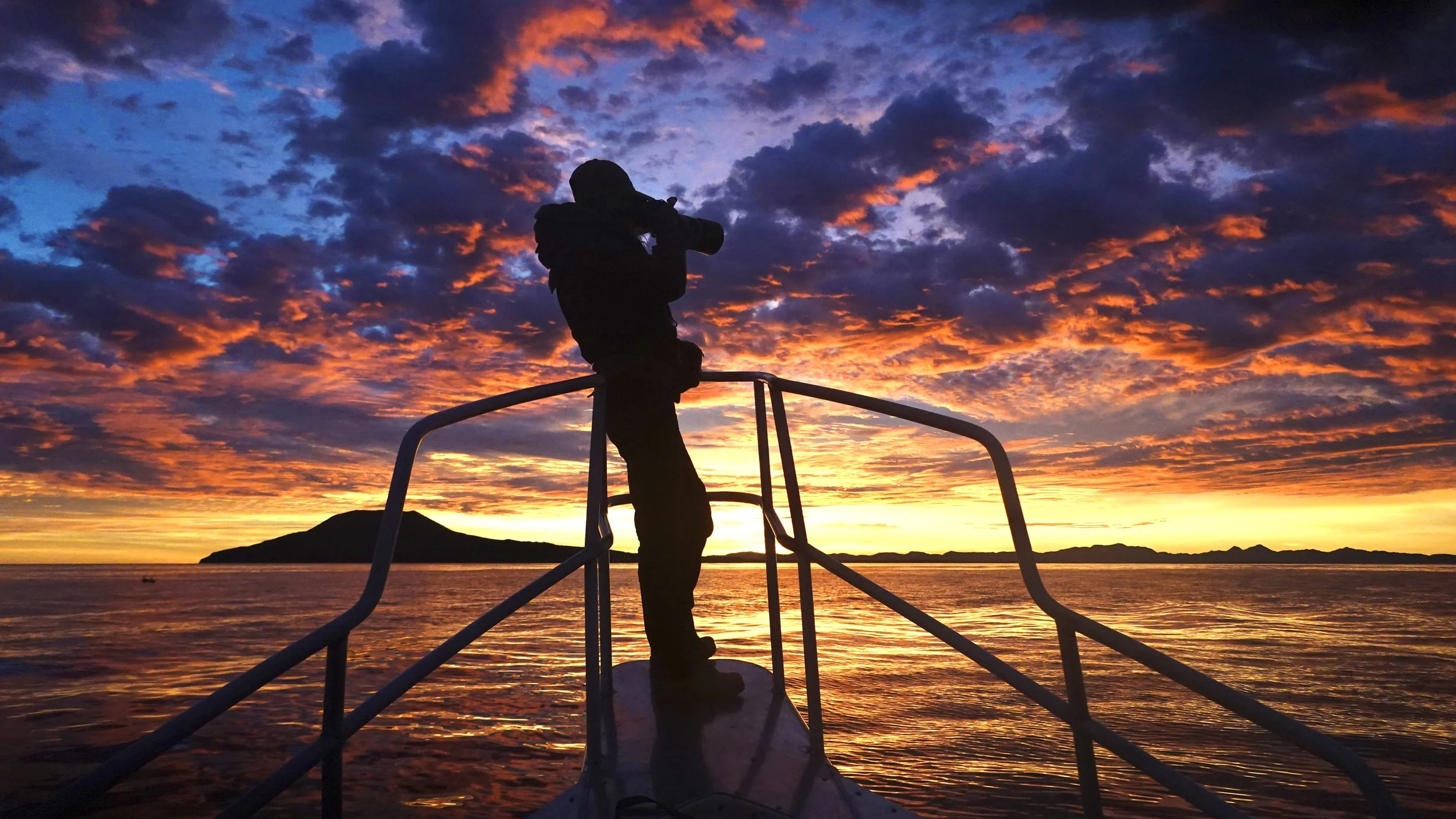
Our vessel La Puma was designed for wildlife observation, with a dedicated elevated bow that gives our guides and guests an exceptional platform for spotting and photographing marine wildlife.
What does responsible whale watching mean?
Mexico regulates whale-watching activities through NOM-131-SEMARNAT-2010, which establishes guidelines for whale observation and the protection of their habitat.
At Baja Adventures, we practice passive wildlife observation, an approach with particularly important roots here in Loreto.
The passive whale-watching method was developed through the long-term work of Dr. Diane Gendron and her research team at CICIMAR-IPN, in collaboration with whale-watching captains and authorities in Loreto Bay National Park. Their research showed that whale-watching vessels could alter blue-whale behavior, while maintaining distance and switching engines off whenever possible reduced disturbance. These observations helped shape what became known locally as passive whale watching.
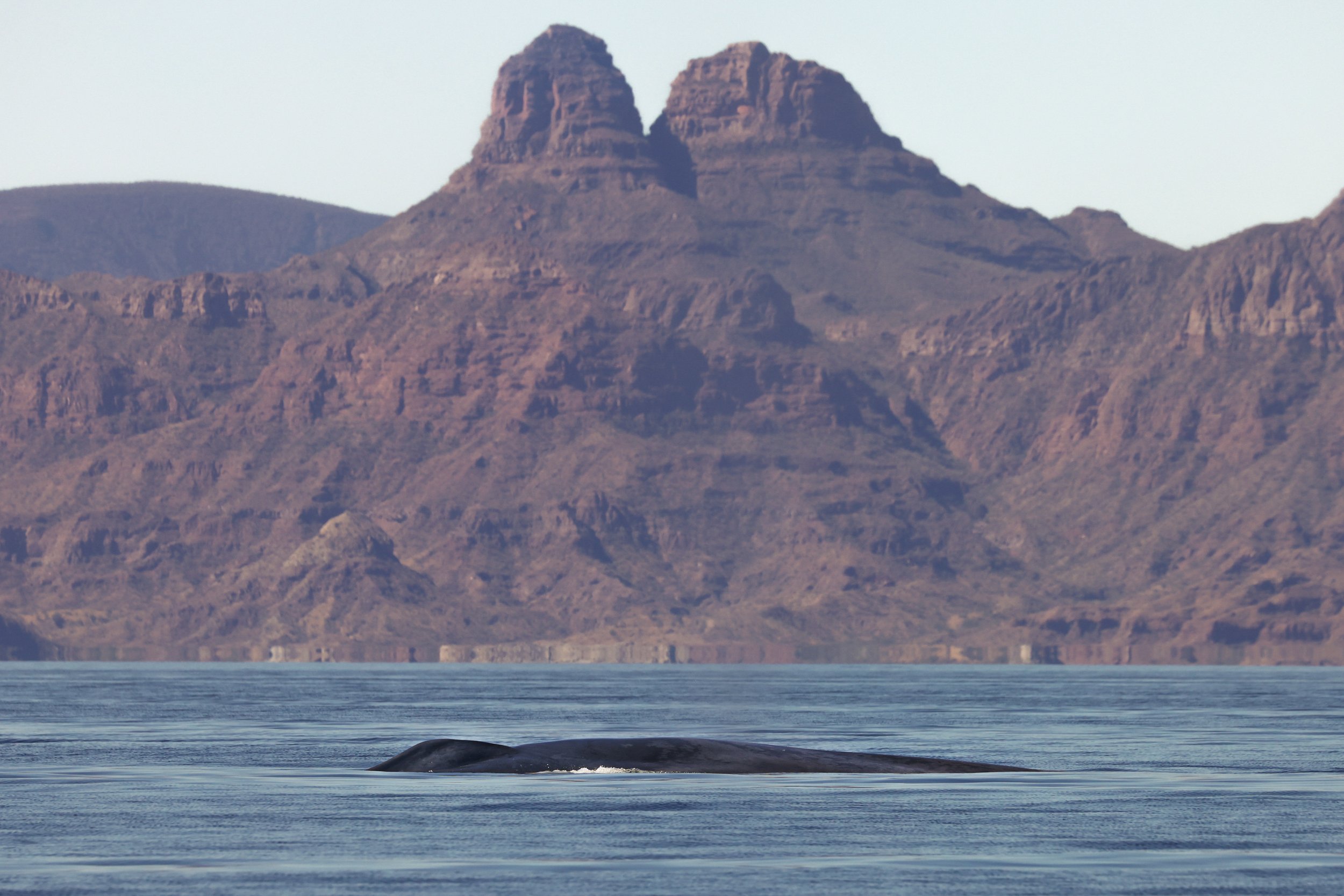
A blue whale surfaces against the Sierra de la Giganta with no other vessels around, an example of the quiet, low-impact wildlife observation we prioritize during our expeditions in Loreto photo by Regina Domingo.
Today, Baja Adventures follows this philosophy in our own expeditions, and we are proud to contribute photographic records to the long-term blue whale photo-identification catalog led by Dr. Gendron and CICIMAR-IPN.
We don't chase whales or attempt to manufacture close encounters. We respect the animals' direction of travel and behavior, and when appropriate, engines may be placed in neutral or switched off while we observe.
There is also an important distinction visitors should understand:
Swimming, freediving and diving with whales are not part of legal whale-watching activities in Mexico.
Our expeditions are observation experiences.
The objective is not to get as close as possible. It is to spend meaningful time in the whales' environment while minimizing our influence on their natural behavior.
Sometimes the most extraordinary encounter happens when we stop approaching the whale and allow the whale to decide what happens next.
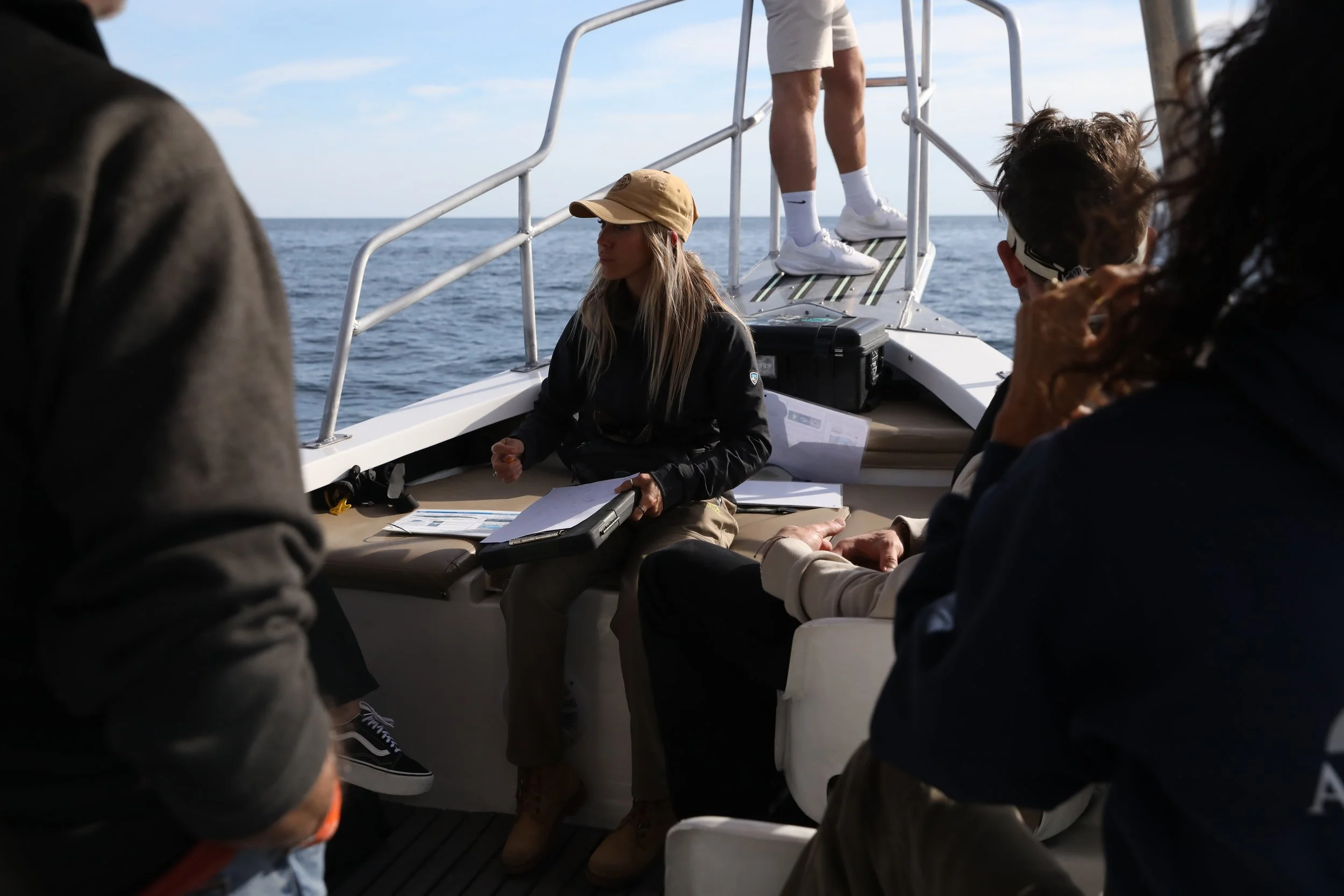
Baja Adventures expedition leader Regina Domingo collecting cetacean distribution data alongside citizen-science participants during a whale expedition in Loreto Bay National Park. Observations gathered in the field contribute to ongoing monitoring and research on cetacean distribution in the region.
What threats do blue whales face?
Their immense size does not make blue whales immune to human impacts.
Major threats include vessel strikes, entanglement in fishing gear and underwater noise.
Changes in ocean conditions can also affect where and when prey becomes available, potentially altering important feeding habitat.
This is why conservation requires more than knowing that whales are present.
We need to understand where they occur, when they occur, what they are doing and how those patterns change over time.
Want to learn more about whales, the Gulf of California and the threats facing this extraordinary marine ecosystem? Explore the conservation initiatives, research and campaigns of our project partner, Nakawe Project, and discover how science and collective action can help protect the Gulf.
Citizen science: studying cetacean distribution in Loreto
Citizen science is not an activity we add after finding wildlife.
It is integrated into the way Baja Adventures explores.
We are participating in a multi-year project analyzing cetacean distribution throughout Loreto Bay National Park and its surrounding waters, in collaboration with scientists and research partners.
Our field observations can include:
species, geographic position, number of individuals, group composition, behavior, environmental conditions and photographic records.

Baja Adventures founder and expedition leader Leopoldo Sanmiguel interpreting the geography and oceanography of the Gulf of California, including currents and seasonal upwelling that influence productivity and marine wildlife around Loreto.
Repeated effort over months and years can reveal patterns that a single observation never could.
Where are different cetaceans concentrating?
How does distribution change between seasons?
Where are mothers and calves observed?
Which areas appear important for feeding?
How does wildlife distribution overlap with environmental and human factors?
Our guests can participate in this process and learn why the information is being collected.
Instead of simply saying:
“We saw three whales.”
we begin asking:
Which species? Where? How many? What were they doing? What were the conditions? Were calves present? Have we photographed this individual before?
That is where observation begins becoming knowledge.
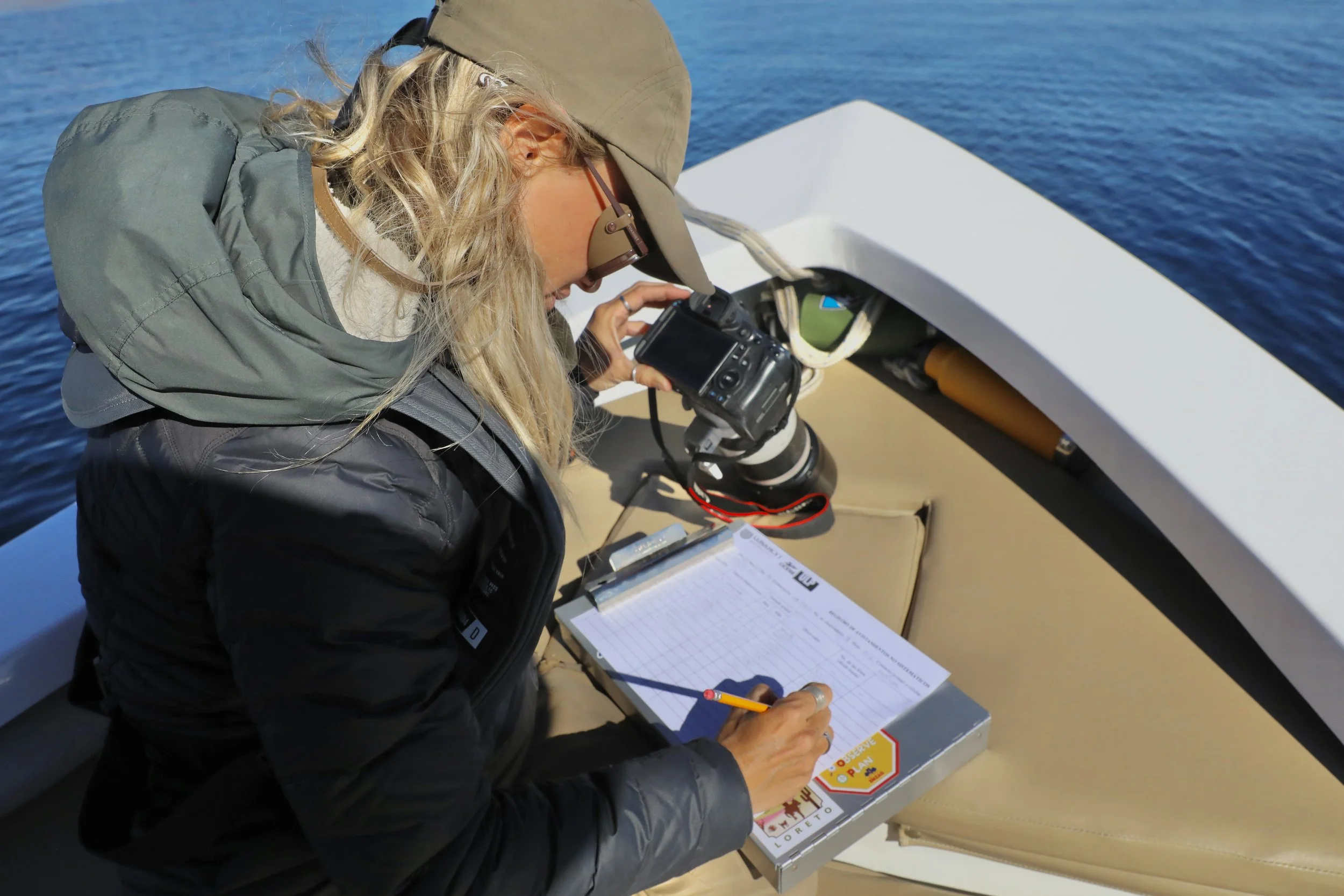
Citizen science in action: our team collects cetacean observations and field data during Baja Adventures expeditions, contributing to the analysis of whale and dolphin distribution in Loreto Bay National Park and surrounding waters
Regenerative tourism: when your expedition contributes to something larger
Sustainable tourism is often described as reducing negative impacts.
Regenerative tourism asks whether tourism can also create something positive.
For Baja Adventures, a guest booking helps create field time.
Field time creates observations.
Observations create data and photographic records.
Those records can contribute to scientific collaboration, environmental education and a better understanding of Loreto's wildlife.
Our model also supports local captains, services and communities while helping create economic value around healthy ecosystems and living wildlife.
Tourism, science and conservation don't have to exist separately.
When thoughtfully designed, they can support one another.
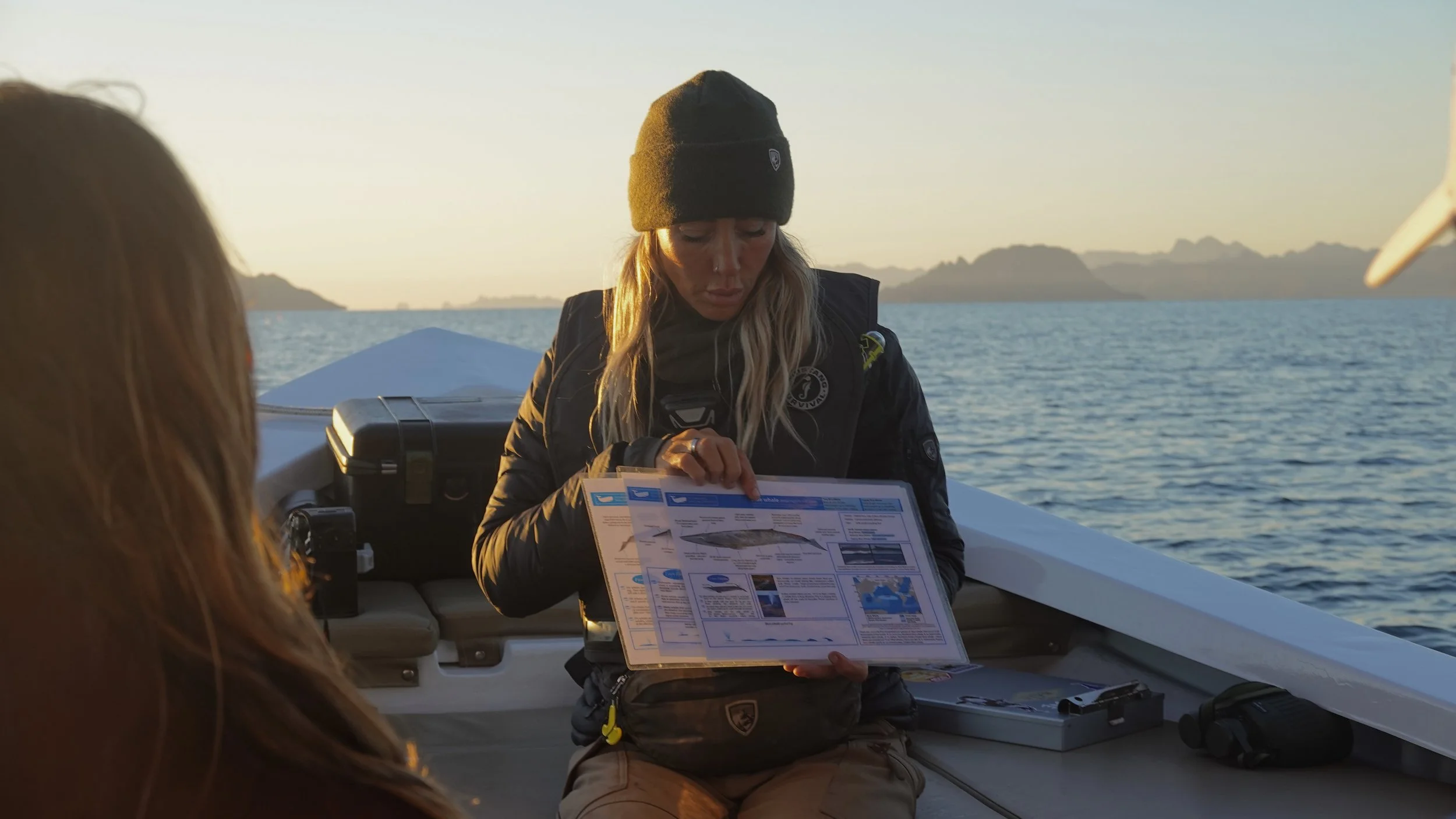
Expedition leader Regina Domingo sharing insights into blue whale ecology with participants during a Baja Adventures whale-watching expedition in Loreto.
Meet La Puma: our whale-watching expedition vessel
Long wildlife expeditions require a boat designed for much more than a quick sightseeing trip.
Our own expedition vessel, La Puma, is a 27-foot super panga equipped for wildlife observation and long days exploring the Sea of Cortez.
She includes:
an onboard WC, extensive shade, individual orthopedic seating, dry storage and a dedicated observation bow, along with professional binoculars, a hydrophone, educational materials, blankets and expedition equipment.
We also carry VHF and satellite communication, advanced first-aid and emergency equipment, oxygen and the safety equipment required for our operations.
Our collective whale expeditions are limited to a maximum of seven guests.
That small-group model gives everyone space to observe, photograph, ask questions and participate in citizen-science activities.
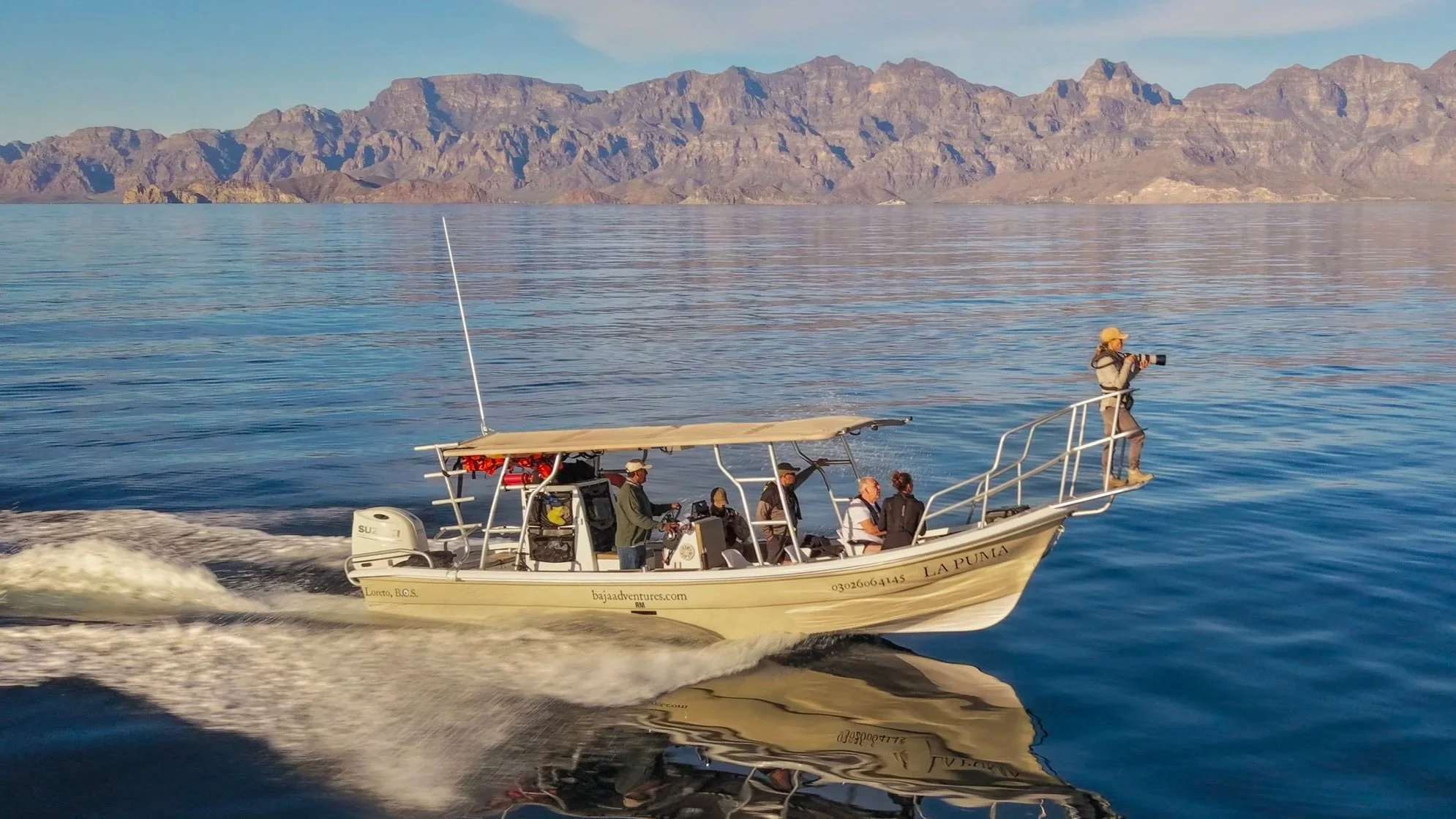
La Puma is our 27-foot expedition vessel designed for wildlife observation and small-group marine exploration.
Who will guide your whale expedition?
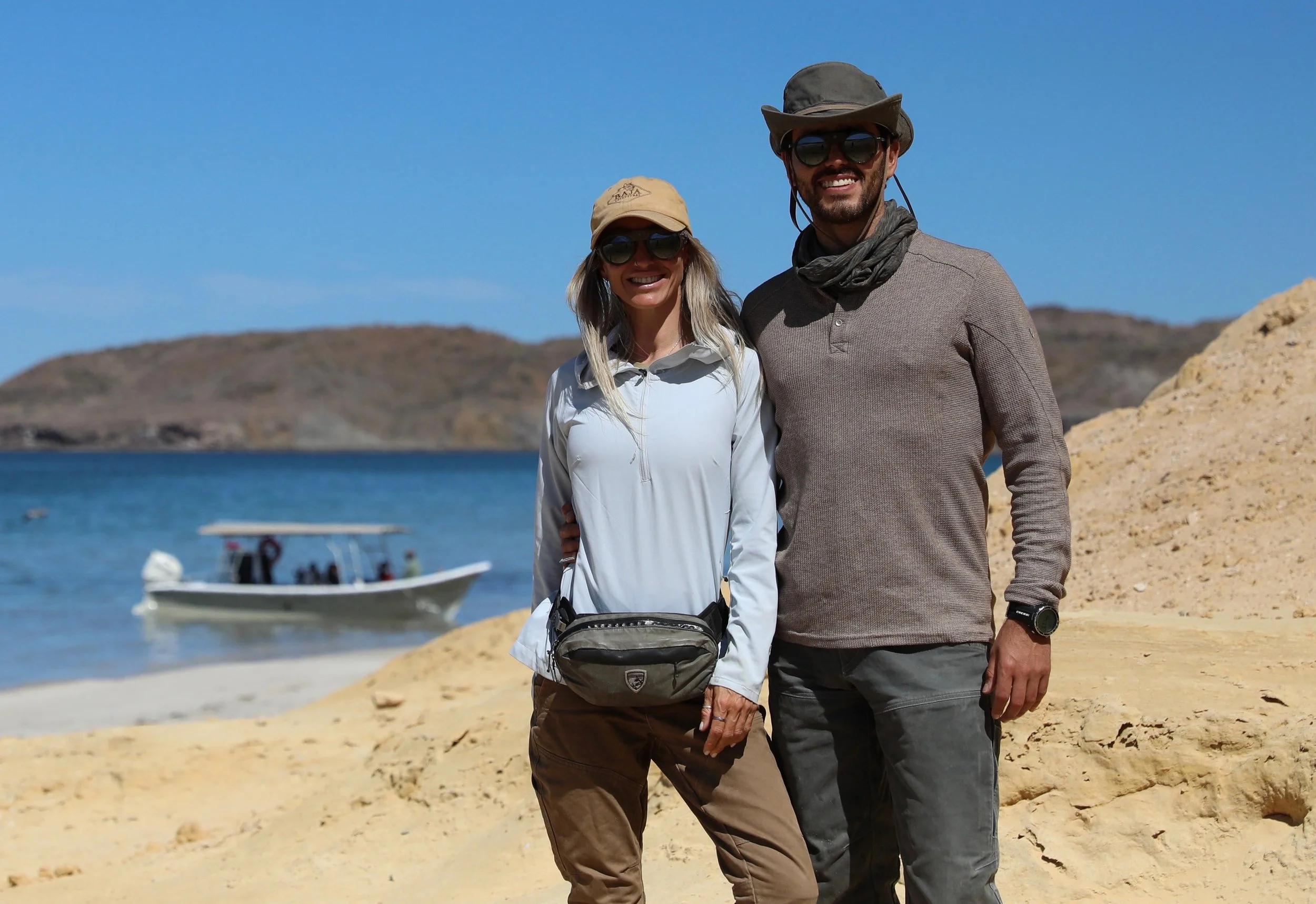
Regina Domingo and Leopoldo Sanmiguel lead Baja Adventures' small-group wildlife and citizen-science expeditions.
Baja Adventures is an owner-operated boutique expedition company founded and operated by Regina Domingo and Leopoldo Sanmiguel.
Leo brings decades of experience exploring the Baja California Peninsula and its remote marine and terrestrial environments.
Regina combines conservation, citizen science, wildlife photography and field monitoring through her work with Baja Adventures and Nakawe Project.
Together, we work as two bilingual guides, accompanied by an experienced local certified captain.
Having two guides allows us to combine wildlife interpretation, guest experience, field observation, photography and citizen-science work without treating the expedition as simply a boat ride.
We operate only one expedition per day.
Our philosophy is closer to a viaje de autor than mass tourism: small groups, carefully designed experiences, local knowledge and enough flexibility to let weather, wildlife and the environment help shape the day.
One-day or multi-day whale watching in Loreto?
There is no single right way to experience whale season.
Our one-day Blue Whale Watching Adventure is approximately 7 hours, designed for travelers who want a full day exploring Loreto Bay National Park and its surrounding waters.
It includes two bilingual guides, an experienced captain, breakfast, healthy snacks, lunch, binoculars, hydrophone, educational materials and citizen-science activities aboard La Puma.
For travelers who want a deeper experience, our multi-day whale itineraries combine several days of marine exploration with experiences such as gray whales, Sierra de la Giganta, desert oases, workshops, citizen science and local culture.
Multi-day travel also provides an important advantage during winter: flexibility.
The Gulf of California can be windy. Having several days gives us more opportunities to adapt the itinerary around safe marine conditions rather than forcing an expedition into a particular day.
Private and bespoke whale expeditions are also available.
What should you bring for whale watching in Loreto?
Winter mornings on the Sea of Cortez can feel surprisingly cool, even when the afternoon becomes warm.
We recommend bringing:
Sun protection, sunglasses and a hat
Layers and a warm jacket for early morning
Comfortable clothing and safe, non-slip footwear
A camera or phone with enough battery and storage
Your usual motion-sickness medication if you require it, taken according to its instructions
Any personal medication you may need during a full day at sea\
You do not need to bring binoculars unless you prefer your own. We provide binoculars aboard our expeditions.
Put the camera down occasionally. Some encounters are better remembered with your own eyes.
For guests who would rather stay fully present in the experience, professional wildlife photography services are also available and can be booked separately, allowing you to enjoy the expedition while we help capture the memories for you
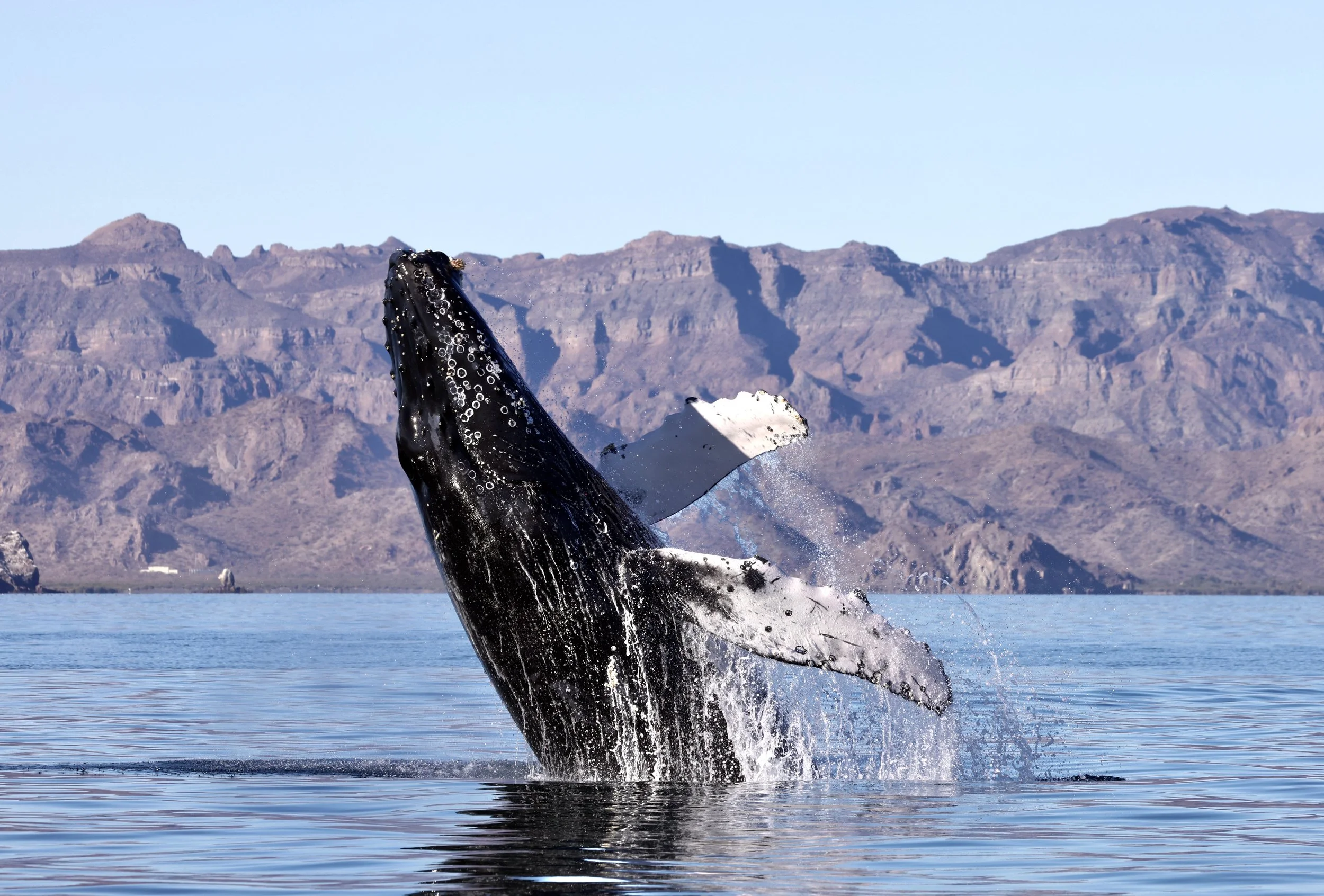
Blue whales are not the only cetaceans encountered during Loreto's winter whale season. Humpback whales are seasonal visitors to the region, photo by our expedition leader Regina Domingo.
What happens if the weather is bad?
Weather is part of expedition travel.
Wind and sea conditions can change quickly during winter, and marine safety always comes first.
Departure times and routes may therefore change according to weather, wildlife distribution, port conditions and instructions from the relevant maritime or protected-area authorities.
If the port is officially closed, we do not operate a marine expedition.
This is also one reason we particularly value multi-day whale itineraries: they give us greater flexibility to adapt activities around the conditions rather than expecting nature to follow a fixed schedule.
Why is whale season such a special time to visit Loreto?
Because whales are only part of the story.
During winter, the desert mountains of the Sierra de la Giganta meet the productive waters of the Sea of Cortez, while the islands of Loreto Bay National Park create one of the most dramatic landscapes in Baja California Sur.
Blue whales may be feeding offshore while dolphins travel between the islands. Humpbacks may appear on the horizon. A fin whale may surface unexpectedly. Seabirds can reveal activity beneath the water.
And behind every encounter are larger questions about migration, feeding, reproduction, ocean productivity and conservation.
This is what makes whale season in Loreto extraordinary.
You don't simply come to see an animal.
You enter an ecosystem.
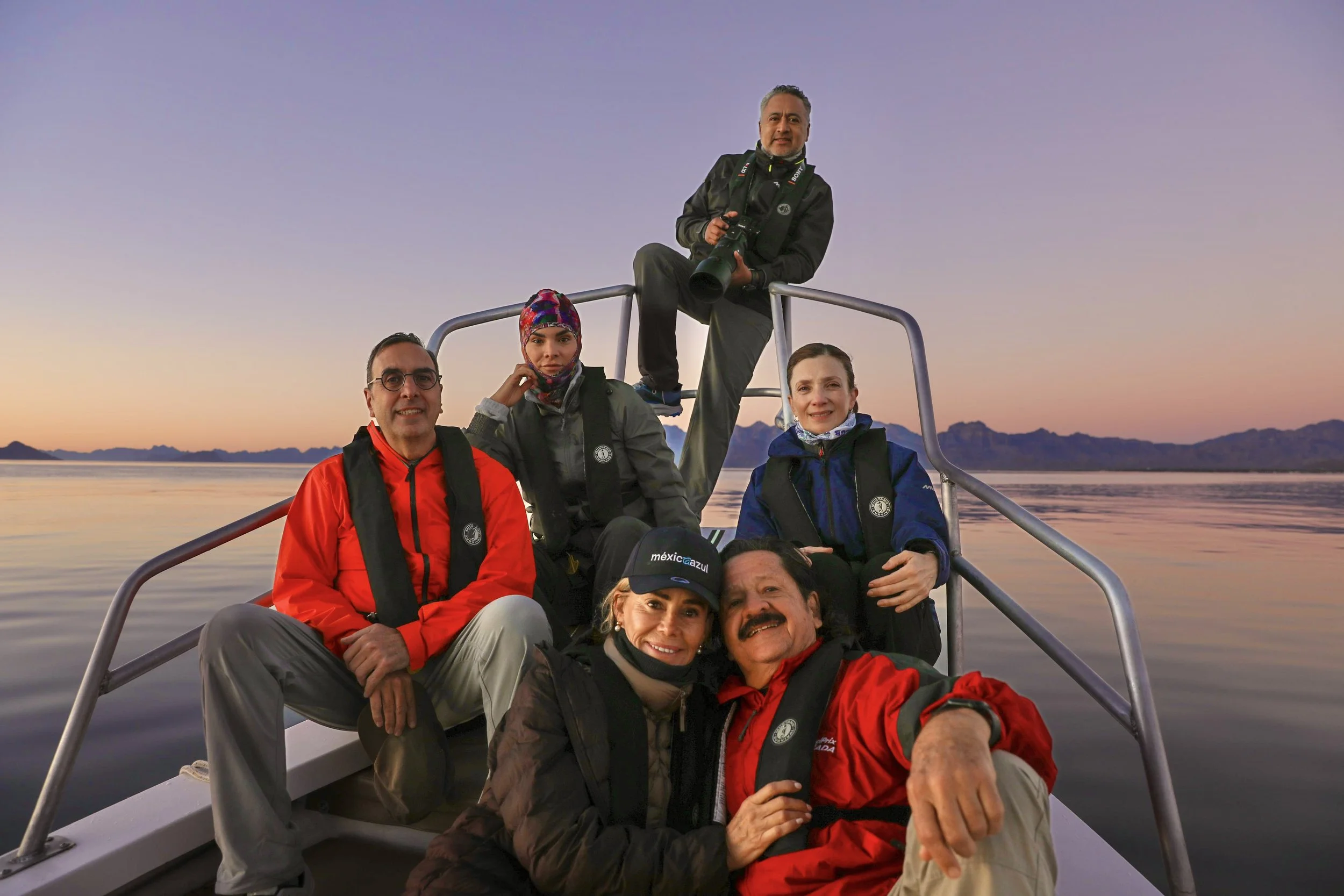
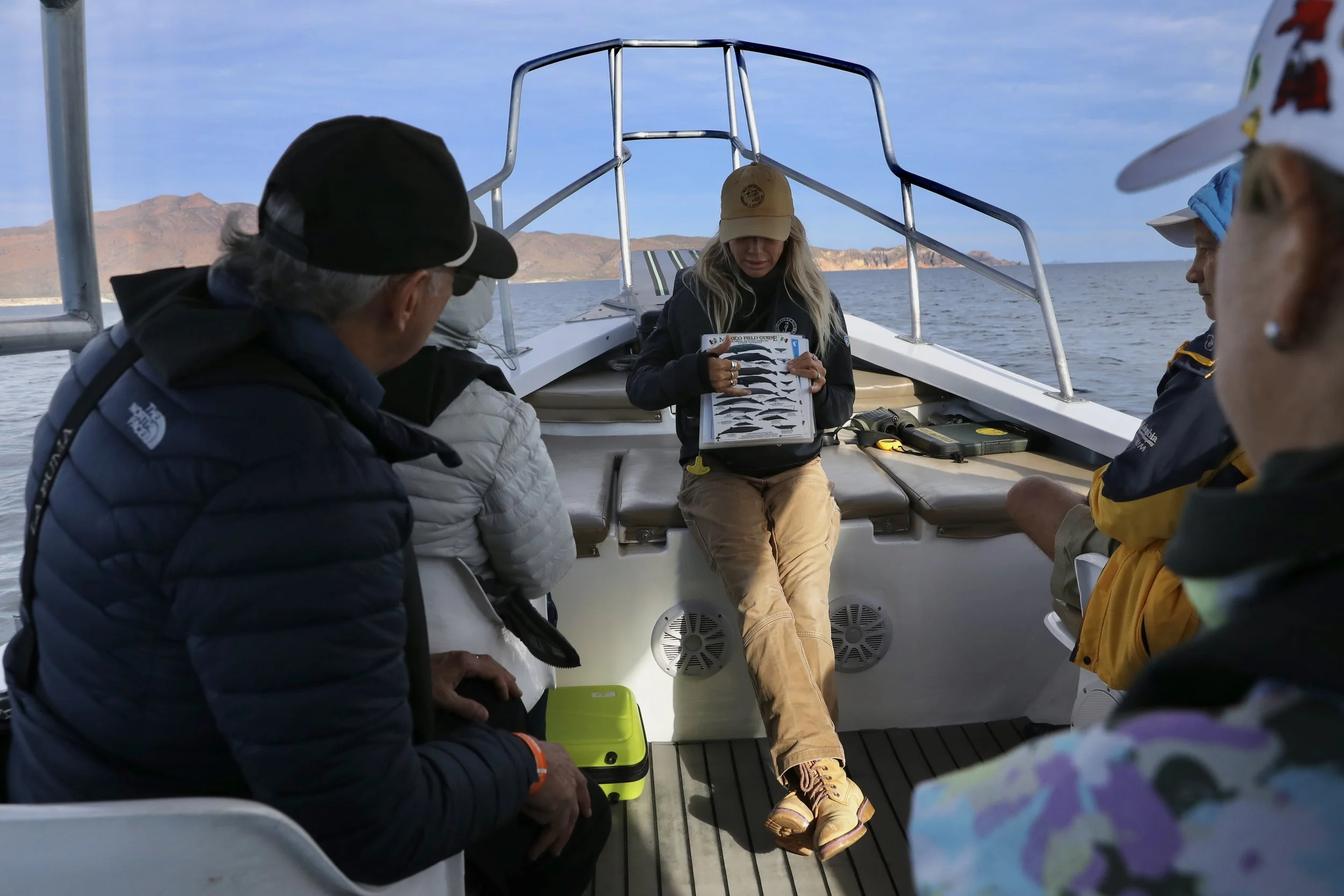
Winter mornings at sea can be cold even in Loreto, Baja California Sur. Layers and wind protection make long whale expeditions considerably more comfortable.
Frequently Asked Questions About Whale Watching in Loreto
When is whale season in Loreto?
The official whale-watching season in Loreto Bay National Park and its surrounding area runs from January through April. The presence and distribution of individual species vary throughout the season and from year to year.
What is the best time to see blue whales in Loreto?
Blue whales are generally observed around Loreto from late January through April. At Baja Adventures, late January through mid-March is typically our principal period for blue-whale-focused expeditions, but wildlife can never be guaranteed.
What other whales can you see in Loreto?
During whale season, possible encounters include humpback whales, fin whales and occasionally orcas, as well as several dolphin species and other marine wildlife. Species and encounters vary daily.
Can you see gray whales in Loreto Bay?
Gray whales' principal winter aggregation areas are on the Pacific side of Baja California Sur, not Loreto Bay. Baja Adventures includes Pacific gray-whale expeditions from Loreto in selected private and multi-day itineraries, with transportation aboard our 4x4 expedition vehicle.
Can you swim with blue whales in Loreto?
No. Swimming, freediving and diving with whales are not part of permitted whale-watching activities under Mexican whale-observation regulations. Baja Adventures offers responsible observation from our authorized expedition vessel.
Are whale sightings guaranteed?
No. Whales are wild animals and their location and behavior are affected by prey, oceanographic conditions, weather, migration and other natural factors.
How long is a Baja Adventures whale-watching expedition?
Our one-day whale expedition is approximately 7 hours, allowing us enough time to explore rather than simply travel to one predetermined location and return.
How many guests are on the boat?
Our collective expeditions are limited to a maximum of seven participants, accompanied by two bilingual guides and an experienced local captain.
Does the boat have a toilet?
Yes. La Puma has an onboard WC, along with shade, individual orthopedic seating, dry storage and a dedicated wildlife-observation bow.
Do you offer multi-day whale expeditions?
Yes. Baja Adventures offers multi-day whale itineraries, private expeditions and bespoke whale journeys that can combine blue whales in Loreto, gray whales on the Pacific side, citizen science and selected land experiences.
How far in advance should I book whale watching in Loreto?
Whale season is one of Loreto's busiest periods, while Baja Adventures operates only one expedition per day and keeps shared groups to a maximum of seven guests. For January through March, we recommend planning and booking well in advance whenever possible.
Come to see a whale. Leave understanding an ecosystem.
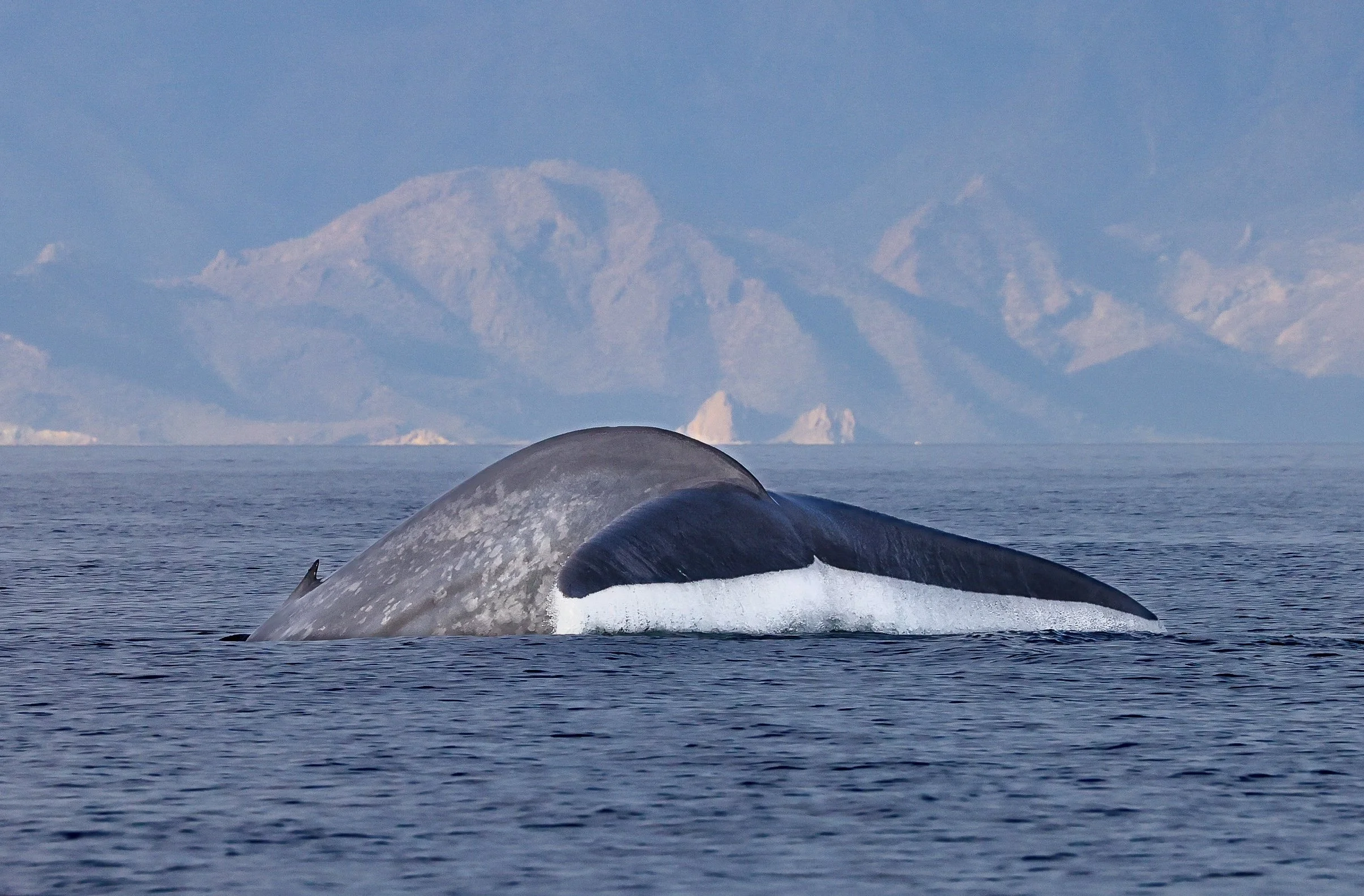
Blue whale fluke surfacing near Loreto during a Baja Adventures whale expedition by Regina Domingo
Seeing a blue whale surface against the islands and mountains of Loreto can be unforgettable.
But we hope our guests leave with something more.
An understanding that the largest animal on Earth depends upon tiny krill. That those krill depend upon a productive ocean. That individual whales can be recognized across decades. That a photograph can become scientific data. That repeated observations can help us understand how cetaceans use this protected marine environment.
And that tourism, when approached differently, can contribute to the knowledge and conservation of the places we are privileged to explore.
At Baja Adventures, we don't simply want to show you whales.
We want you to understand the extraordinary ecosystem that brings them to Loreto—and become part of its conservation story.